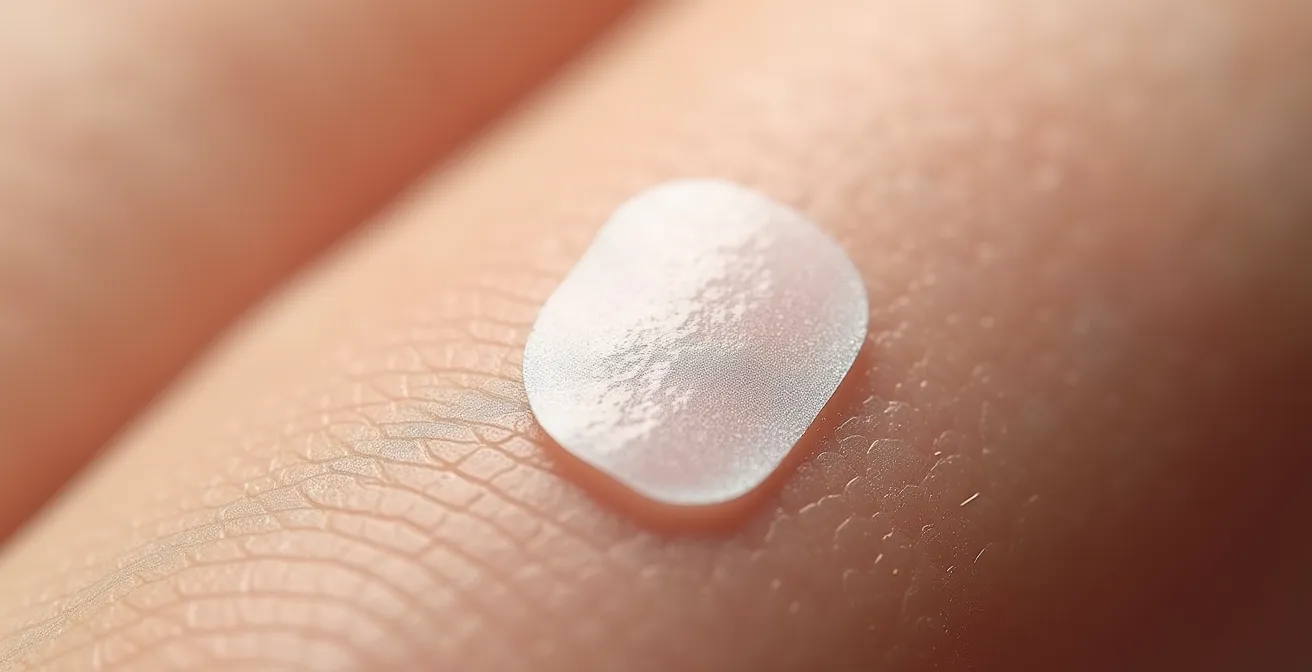
A nicotine patch that won’t stick is more than an annoyance; it’s a failure of its drug delivery system that undermines your quit attempt. The common advice to “clean and dry” the skin is often not enough. The solution lies in adopting a clinical application protocol that treats your skin like a medical surface, focusing on proper degreasing with alcohol to ensure a bond strong enough to last the full 24 hours, even through a shower.
There’s little more frustrating than finding your expensive nicotine patch has peeled off in your sleep or after a shower. You’re invested in quitting, but the very tool designed to help is failing. You’ve likely heard the standard advice: apply it to a clean, dry, hairless area and avoid lotions. Yet, for many, the patch still lifts, curls, and falls off, wasting money and disrupting the steady stream of nicotine needed to keep cravings at bay.
This common failure often leads people to believe the patches are faulty or that their body is somehow “rejecting” them. The problem isn’t the patch or your skin; it’s the procedure. The standard advice overlooks a critical step that medical professionals use for securing transdermal devices. The real key isn’t just cleaning the skin—it’s preparing it with a specific protocol.
Instead of treating your patch like a simple sticker, we must approach it as a transdermal drug delivery system. This guide will walk you through the clinical-grade protocol to ensure your patch stays on. We’ll move beyond the basics to cover why adhesion fails and provide a step-by-step fix. We will also address common patient concerns, such as vivid dreams, skin irritation, and what to do if you slip up and smoke, transforming your relationship with your patch from one of frustration to one of confidence.
This article provides a complete guide to mastering your nicotine replacement therapy (NRT). The following sections detail everything from perfect application to managing side effects and accessing resources.
Summary: A Clinical Guide to Making Your Nicotine Patch Work for You
- The Alcohol Wipe Trick for 24-Hour Patch Adhesion
- Why Patches Cause Vivid Dreams and How to Stop It?
- 16-Hour vs 24-Hour Patches: Which Is Best for Your Cycle?
- Is It Dangerous to Smoke While Wearing a Patch?
- Rotating Application Sites to Avoid Red Rashes
- How to Get Free Patches and Gum Mailed to Your Door?
- Vinegar or TSP: What Actually Removes Tar from Walls?
- The “Park and Chew” Method: Are You Using Nicotine Gum Wrong?
The Alcohol Wipe Trick for 24-Hour Patch Adhesion
The number one reason a nicotine patch fails to stick is improper skin preparation. While washing with soap and water removes surface dirt, it doesn’t remove the natural skin oils (sebum) that act as a barrier to the patch’s adhesive. This is why your patch might feel secure at first but peels away hours later, especially with heat or moisture. The solution is to think like a clinician preparing for an injection: you must degrease the skin.
The “trick” is using a 70% isopropyl alcohol wipe on the application site *after* washing and drying. The alcohol effectively dissolves the oils that prevent the patch’s adhesive matrix from forming a complete, waterproof seal with your epidermis. After wiping with alcohol, it’s crucial to let the area air-dry completely for 30 to 60 seconds. Applying the patch to even slightly damp skin will trap moisture and compromise the bond. Once dry, press the patch firmly for a full 10 seconds to activate the pressure-sensitive adhesive. This ensures the patch can withstand sweat, movement, and even a shower.
This simple, two-step cleaning process—wash with soap, then degrease with alcohol—transforms the application from a hopeful guess into a reliable clinical procedure. It is the single most effective change you can make to guarantee 24-hour adhesion and ensure you are receiving the consistent dose of nicotine necessary for a successful quit attempt. The CDC outlines a clear protocol for this, emphasizing that proper skin prep is fundamental to the medicine’s effectiveness.
Why Patches Cause Vivid Dreams and How to Stop It?
One of the most talked-about side effects of the 24-hour nicotine patch is the onset of unusually vivid or bizarre dreams. While sometimes entertaining, they can often be disturbing and disrupt sleep. This phenomenon occurs because the patch delivers a continuous stream of nicotine into your system, even while you sleep. Nicotine is a stimulant that affects neurotransmitters in the brain, including acetylcholine, which plays a role in REM sleep—the stage where most dreaming occurs. This constant stimulation can intensify dream activity, leading to the “nicotine dreams” many users report.
Fortunately, managing this side effect is straightforward. The most effective strategy, recommended by experts at Harvard Medical School, is to simply remove the 24-hour patch an hour or two before you go to bed and apply a fresh one immediately upon waking. This breaks the continuous overnight nicotine delivery, allowing your brain’s sleep cycles to normalize. The key is consistency: always apply the new patch as soon as you wake to prevent a sharp drop in nicotine levels, which can trigger intense morning cravings. If you feel a craving in the morning while waiting for the new patch to take effect (it can take an hour or two to reach peak levels), you can use a fast-acting NRT like nicotine gum or a lozenge to bridge the gap.

According to research from Australia’s Quit Organization, these vivid dreams often resolve on their own within a few days of starting NRT as your body adapts. They also note that reducing caffeine intake later in the day can further help prevent sleep disturbances. Experimenting with removing the patch at different intervals before sleep—one, two, or even three hours—can help you find the optimal timing that prevents dreams without causing you to wake up with cravings.
16-Hour vs 24-Hour Patches: Which Is Best for Your Cycle?
Choosing between a 16-hour and a 24-hour patch isn’t about which one is “better” overall, but which one is better for your personal nicotine-dependence cycle and lifestyle. The primary difference is how they align with your body’s needs, particularly concerning sleep and morning cravings. The 24-hour patch provides a continuous, steady dose of nicotine, which is excellent for heavy smokers who even wake up in the night with cravings. However, as discussed, this is also the patch that can cause sleep disturbances and vivid dreams.
The 16-hour patch, on the other hand, is designed to be worn only during your waking hours (e.g., 7 AM to 11 PM). You apply it in the morning and remove it before bed. This mimics the nicotine-intake pattern of a typical smoker and completely avoids the issue of sleep disruption from overnight nicotine stimulation. The downside is that you may wake up with stronger morning cravings, as your nicotine levels will have dropped to zero overnight. For many users, this is a manageable trade-off for a better night’s sleep.
So, which is for you? If you are a heavy smoker who struggles with intense morning cravings, or if you don’t experience sleep issues, the 24-hour patch may offer the smoothest experience. If you find your sleep is being disrupted or you experience vivid dreams, or if you were a lighter smoker, the 16-hour patch is an excellent alternative. It’s also worth noting that the 16-hour patch has a proven track record of success; a landmark New England Journal of Medicine study demonstrated a quit rate of 41% at 12 weeks for users, significantly higher than placebo. The best approach is to start with one type and be prepared to switch if it doesn’t fit your body’s response.
Is It Dangerous to Smoke While Wearing a Patch?
A common fear among people starting NRT is the danger of smoking a cigarette while wearing the patch. The concern is about a “nicotine overdose,” and it’s a valid question. While it’s true that you are introducing more nicotine into your system, the situation is rarely as dangerous as many believe. For most people, having a single cigarette while wearing a patch will not cause a serious medical issue. You might feel unpleasant symptoms like nausea, dizziness, or a rapid heartbeat, which are signs of nicotine over-exposure, but a life-threatening event is highly unlikely.
The most important piece of advice is: do not panic and do not immediately remove the patch. A slip-up is a normal part of many people’s quit journey. Removing the patch abruptly will cause your nicotine levels to crash later, dramatically increasing the risk of a full-blown relapse. According to CDC guidelines, you do not need to stop using the patch if you slip up and have a cigarette. The correct protocol is to monitor yourself for severe symptoms. If you feel very unwell, contact a healthcare provider. Otherwise, dispose of any remaining cigarettes, recommit to your quit plan, and keep the patch on as directed.
Interrupting your NRT because of a slip-up is often a bigger threat to your long-term success than the slip-up itself. The goal of the patch is to manage cravings and withdrawal over the long term. One cigarette does not negate that process. The clinical approach is to see the slip-up not as a failure, but as a data point. It’s a sign that your current NRT dosage or strategy may need adjustment, perhaps by adding a faster-acting NRT like gum for moments of intense craving. The key is to continue the treatment and refocus on the goal.
Rotating Application Sites to Avoid Red Rashes
After mastering adhesion, the next challenge many patch users face is skin irritation. A red, itchy, or slightly swollen rash can develop at the application site, a condition known as contact dermatitis. This is typically a reaction to either the nicotine itself or, more commonly, the adhesive used in the patch. If you use the same spot of skin every day, this irritation can become severe and painful, tempting you to stop using the patch altogether. The solution is a systematic site rotation protocol.
The core principle is simple: never apply a new patch to the same spot for at least one week. This gives the skin ample time to recover and reduces the cumulative irritation. To do this effectively, create a mental “body map” and follow a schedule. For example:
- Monday: Left upper arm
- Tuesday: Right upper arm
- Wednesday: Left upper chest
- Thursday: Right upper chest
- Friday: Left shoulder/back
- Saturday: Right shoulder/back
- Sunday: A different spot on your hip or inner arm

By rotating through these clean, dry, hairless areas, you minimize the risk of severe irritation. According to recommendations for veterans quitting smoking, this daily rotation is a cornerstone of successful NRT use. If irritation persists despite proper rotation, consider switching patch brands, as different manufacturers use different adhesives, and you may be sensitive to one type but not another. For mild irritation that has already occurred, you can apply an over-the-counter 1% hydrocortisone cream to the area *after* you have removed the patch for the day (or on your non-patch skin), but never apply it under a new patch.
How to Get Free Patches and Gum Mailed to Your Door?
One of the biggest barriers to a successful quit attempt can be the cost of Nicotine Replacement Therapy. Patches and gum can be expensive, and the financial strain can cause people to use them incorrectly (e.g., cutting patches in half) or stop using them altogether. What many people don’t realize is that robust, free support is available. In the United States, every state has a publicly funded “quitline” program designed to remove this financial barrier.
These programs provide free coaching and, in most cases, a starter kit of NRT products mailed directly to your home. Accessing this resource is simple and is a cornerstone of public health efforts to reduce smoking. The process generally involves these steps:
- Call the national portal number: 1-800-QUIT-NOW (1-800-784-8669). You will be automatically routed to your state’s specific program.
- Complete a brief eligibility screening. Typically, you must be 18 or older and be planning to quit within the next 30 days.
- Participate in a short coaching session over the phone, where a trained specialist will help you create a personalized quit plan.
- Receive a supply of free NRT, usually a 2-to-8-week supply of patches, gum, or lozenges, shipped to your home.
This service is not a gimmick; it’s a proven public health strategy. For example, the Massachusetts quitline provides up to 8 weeks of free NRT and has specialized support for different populations. And this is not an isolated case; according to recent program data, all 50 U.S. states operate these quitlines. By taking advantage of these programs, you not only get free medical support but also the expert guidance that can significantly increase your chances of quitting for good.
Vinegar or TSP: What Actually Removes Tar from Walls?
As you progress in your quit journey, reclaiming your environment from the physical remnants of smoking is a powerful psychological step. The yellow, sticky film of tar on walls and ceilings is not just an aesthetic issue; it’s an olfactory trigger that can spark cravings. Cleaning it away is a crucial part of a comprehensive environmental cleanse. The two most effective cleaning agents for this task are Trisodium Phosphate (TSP) and simple white vinegar, but they are used for different levels of buildup.
For heavy, stubborn tar accumulation from years of indoor smoking, TSP is the heavy-duty solution. It is a powerful chemical cleaner that cuts through the thickest layers of nicotine and tar residue. You mix the powder with warm water according to the product’s directions, wear protective gloves and eyewear, and wash the walls with a sponge. It’s extremely effective but requires good ventilation and a follow-up rinse with clean water. It is the go-to choice for restoring heavily stained surfaces.
For lighter residue or as a final deodorizing step after using TSP, a solution of white vinegar and water is an excellent, less-toxic option. A 50/50 mix of white vinegar and warm water in a spray bottle can be used to wipe down walls, neutralizing lingering smoke odors. This method is best for situations where the tar buildup is minimal. A full “quitter’s deep clean” involves more than just walls; it includes washing all fabrics, steam cleaning carpets, changing HVAC filters, and removing all ashtrays and lighters to eliminate all visual and scent-based smoking cues from your home.
Key Takeaways
- Proper patch adhesion requires a clinical approach: wash with soap and water, then degrease the skin with a 70% isopropyl alcohol wipe.
- Manage vivid dreams by removing a 24-hour patch before bed and applying a new one upon waking, or by switching to a 16-hour patch.
- Avoid severe skin irritation by following a strict 7-day site rotation, ensuring no spot is reused for at least one week.
The “Park and Chew” Method: Are You Using Nicotine Gum Wrong?
For many, the nicotine patch is the foundation of their NRT, but it’s often not enough to handle sudden, acute cravings. This is where fast-acting NRT like nicotine gum comes in, and research shows that this combination therapy is more effective than using the patch alone. However, most people use nicotine gum incorrectly, chewing it like regular gum. This mistake leads to an unpleasant taste, hiccups, an upset stomach, and—most importantly—poor nicotine absorption. Chewing it continuously releases all the nicotine at once into your saliva, where most of it gets swallowed and destroyed by stomach acid instead of being absorbed.
The correct technique is the “Park and Chew” method. This method is designed for slow, buccal absorption, where the nicotine is absorbed through the lining of your cheek. It ensures a steady, effective dose that can successfully beat back a craving. The process is a simple cycle that you repeat for about 30 minutes, or until the tingling sensation is gone.
Your Action Plan: The ‘Park and Chew’ Protocol
- Chew the gum slowly just until you feel a peppery taste or a slight tingling sensation. This signals the release of nicotine.
- Stop chewing and “park” the gum between your cheek and your gum. Hold it there.
- Wait until the tingling sensation fades, which usually takes about a minute. The nicotine is being absorbed during this time.
- Resume chewing slowly until the tingle returns, then park it again in a different spot.
- Repeat this chew-and-park cycle for about 30 minutes to extract the full dose from the piece of gum.
By mastering this technique, you turn nicotine gum from an often unpleasant experience into a powerful and reliable tool. Research shows that combination NRT—using a long-acting patch for baseline support and a short-acting product like gum for breakthrough cravings—can significantly boost your chances of quitting successfully. It provides a comprehensive defense against both the background hum of withdrawal and the sudden, sharp spikes of craving.
By implementing this full clinical protocol—from skin preparation to combination therapy—you are taking control of your quit journey and giving yourself the best possible chance of success. Evaluate these strategies and begin applying them today to build a robust and resilient quit plan.