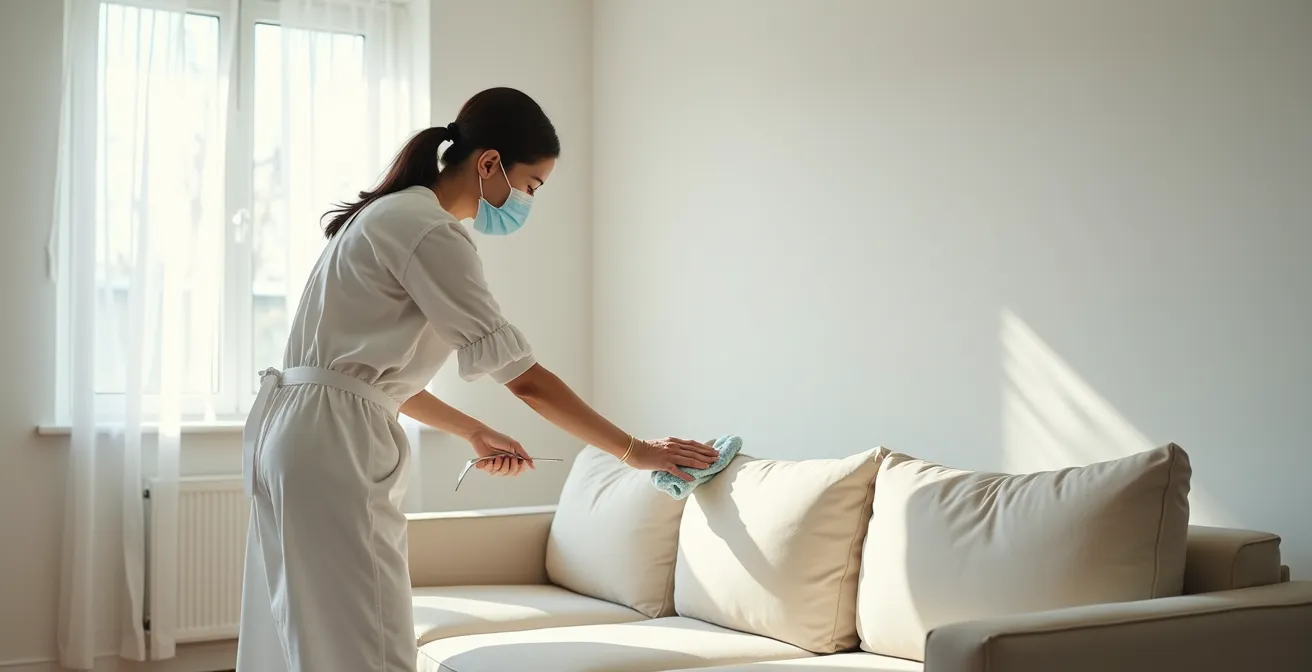
The lingering smell of smoke is a sign of toxic chemical residue that simple cleaning won’t remove; true elimination requires a full-scale decontamination of your home environment.
- Effective removal depends on treating porous surfaces (fabric, drywall) and non-porous surfaces (glass, metal) with different, appropriate methods.
- Cross-contamination is a major risk, especially when washing fabrics, requiring isolated and specialized cleaning protocols.
Recommendation: Adopt a systematic, multi-step decontamination strategy for your entire home, car, and belongings, rather than relying on simple odor-masking or surface cleaning.
You’ve done the hard part—you quit smoking. It’s a monumental achievement for your health and your family’s well-being. Yet, a ghost of the habit remains. It’s a stale, sour smell that clings to the curtains, seems embedded in the sofa, and greets you from the walls when you walk in. For a parent, this isn’t just an unpleasant odor; it’s a constant, worrying reminder of the toxic legacy left behind. This is third-hand smoke (THS): the chemical residue that gasses and particles from tobacco smoke leave on every surface they touch.
Many common suggestions, like washing walls with vinegar or sprinkling baking soda, are little more than temporary fixes. They might briefly mask the smell, but they fail to address the core issue: the toxic residue that has chemically bonded with your home’s surfaces. This residue includes nicotine, tar, and a host of volatile organic compounds (VOCs) that continue to off-gas long after the smoke has cleared. Treating this problem requires a shift in mindset. You are not simply cleaning a dirty house; you are undertaking an environmental detoxification project.
This guide moves beyond superficial advice to provide a practical, thorough protocol from an environmental hygiene perspective. We will detail the specific methods required to decontaminate walls, vehicle interiors, and fabrics. We’ll also explore how to maintain your newly cleaned environment and even how the air you breathe impacts your body’s own recovery process. The goal is not just to get rid of a smell, but to permanently remove the toxic residue and reclaim a truly healthy living space for your family.
For those tackling the most common starting point—the walls—this video provides a helpful visual guide on the techniques involved in removing stubborn nicotine buildup.
To systematically address every contaminated area of your home and life, this article is structured to guide you through each critical step. The following summary outlines the key decontamination zones we will cover, from the largest surfaces in your home to the personal habits that protect your progress.
Summary: A Systematic Guide to Eliminating Third-Hand Smoke
- Vinegar or TSP: What Actually Removes Tar from Walls?
- Detailing Your Car: How to Get the Smell Out of Upholstery?
- Changing Filters: Is Smoke Hiding in Your Air Ducts?
- The Mistake of Washing Smokey Clothes With Regular Laundry
- How to Ask Guests Not to Smoke in Your Newly Clean Home?
- Using Humidifiers to Help Cilia Move Freely Again
- Cleaning the Car vs Selling It: How Extreme Should You Go?
- Optimizing Sleep Quality: Why You Wake Up Earlier After Quitting?
Vinegar or TSP: What Actually Removes Tar from Walls?
The yellow-brown film on the walls of a former smoker’s home isn’t just a stain; it’s a sticky, resinous matrix of tar and nicotine that has chemically bonded to the paint and drywall. This is why a simple wipe-down with vinegar and water is often ineffective. While vinegar can handle light surface grime, it lacks the chemical power to break down and lift years of accumulated tar. For effective decontamination, you need a more powerful alkaline cleaner designed to dissolve these stubborn compounds.
Historically, Trisodium Phosphate (TSP) was the go-to product for this task due to its aggressive cleaning power. However, its significant environmental impact has led to it being banned in many regions. Fortunately, modern chemistry offers effective and safer alternatives. Professional glycol-based cleaners and phosphate-free TSP substitutes are now the recommended solutions for heavy buildup. These products work by breaking the chemical bonds of the tar, allowing it to be lifted from the surface instead of just smeared around.
The following table, based on a comparative analysis of cleaner effectiveness, illustrates why choosing the right chemical agent is the most critical first step in wall decontamination.
| Cleaner Type | Effectiveness on Tar | Environmental Impact | Safety Requirements |
|---|---|---|---|
| TSP (Trisodium Phosphate) | Excellent (90-95%) | High – Banned in 16 states | Gloves, goggles, ventilation required |
| Phosphate-Free TSP Substitute | Good (70-80%) | Low – Biodegradable | Basic protective gear |
| Vinegar Solution | Fair (40-50%) | Minimal – Natural | Minimal protection needed |
| Glycol-based Cleaners | Very Good (85-90%) | Moderate | Professional handling recommended |
Once you have selected the appropriate cleaner, follow a methodical process. Always work from the top of the wall downwards to prevent streaking from dirty runoff. After cleaning, a thorough rinse with clean water is essential to remove any leftover chemical residue. For severe cases, even after cleaning, you must apply a specialized odor-blocking, stain-sealing primer before repainting. Painting directly over the cleaned surface without this sealing step will almost certainly result in the yellow tar stains bleeding through the new paint over time.
Action Plan: Professional Wall Cleaning Protocol for Tar Buildup
- Test your chosen cleaning solution on a small, inconspicuous area to ensure it doesn’t damage the surface.
- For very light residue, start with a mix of 1/2 cup white vinegar in 2 cups of water. If ineffective, escalate your cleaner.
- For moderate buildup, use a phosphate-free TSP substitute, carefully following the manufacturer’s dilution and safety instructions.
- For heavy, years-old tar, use a professional glycol-based cleaner, wearing appropriate protective equipment (gloves, goggles).
- Once cleaned and rinsed, assess the wall. If any staining or odor remains, apply a high-quality, shellac-based or oil-based odor-blocking primer before applying your final paint color.
Detailing Your Car: How to Get the Smell Out of Upholstery?
A vehicle’s interior is a concentrated environment for third-hand smoke contamination. The enclosed space allows smoke to permeate every surface, from the porous seat upholstery and headliner to the non-porous dashboard and glass. As restoration professionals note, smoke residue doesn’t just create an odor; it causes significant physical damage over time, as harmful chemicals are absorbed by fabric fibers, leading to discoloration and degradation. Simply cleaning the hard surfaces is insufficient, as the primary odor reservoir is the soft, porous material that has acted like a sponge.
Thorough decontamination starts with a deep cleaning of all fabric. This involves more than a simple vacuum. An industrial-grade hot water extractor, combined with a specialized enzymatic cleaner, is needed to penetrate the fibers and break down the tar and nicotine particles. All floor mats should be removed, shampooed, and pressure-washed. The cabin air filter is another critical component that must be replaced, as it will be saturated with smoke particles.

For severe and persistent odors that remain after deep cleaning, a professional ozone treatment is the final and most effective step. As seen in the setup above, an ozone (O3) generator is placed inside the sealed vehicle. Ozone is a highly reactive molecule that works by oxidizing the odor-causing compounds, chemically neutralizing them. This process is highly effective but must be done by professionals, as high concentrations of ozone are harmful to breathe and can damage rubber and plastic if applied incorrectly. The treatment effectively “reaches” where cleaning cloths can’t, decontaminating the air-conditioning system and the deepest parts of the upholstery.
Changing Filters: Is Smoke Hiding in Your Air Ducts?
Your home’s HVAC (Heating, Ventilation, and Air Conditioning) system is the respiratory system of your house. If someone smoked indoors, this system has efficiently circulated smoke particles and gasses into every room, and the ductwork itself has become a repository for toxic residue. The first and simplest line of defense is upgrading your furnace filter. Standard, cheap fiberglass filters do almost nothing to capture smoke particles. You need a high-efficiency filter with a MERV (Minimum Efficiency Reporting Value) rating of 11 to 13.
According to HVAC industry standards, high-efficiency filters like these are necessary because they can capture the microscopic particles characteristic of tobacco smoke. For instance, MERV 11-13 filters capture 65-85% of particles between 0.3 and 1.0 microns in size. For even greater effectiveness, pairing a MERV 13 filter with an activated carbon pre-filter can help adsorb the VOCs and gasses that particulate filters miss.
However, changing the filter may not be enough. If significant smoking occurred over many years, the ductwork itself may be coated in residue. The decision to invest in professional duct cleaning should be based on several factors:
- Visible residue or dust coming from the supply vents.
- More than five years of consistent indoor smoking occurred in the home.
- Family members suffer from respiratory conditions like asthma, which are exacerbated by THS.
- You are moving into a home previously occupied by smokers.
It’s important to have realistic expectations. Research from San Diego State University on THS remediation found that while professional cleaning methods immediately reduced nicotine contamination, the levels began to rise again over the following months. This suggests that residue can leach out of materials like drywall and insulation back into the environment. Therefore, ongoing filtration and ventilation are crucial parts of a long-term management strategy, not just a one-time fix.
The Mistake of Washing Smokey Clothes With Regular Laundry
One of the most common errors in dealing with smoke-contaminated fabrics is treating them like regular laundry. Tossing a smokey jacket in with your family’s clothes creates a significant risk of cross-contamination. The tar and nicotine residues are oily and tenacious; in the wash, they can detach from the contaminated item and redeposit onto every other piece of fabric in the machine. Instead of cleaning one item, you end up with an entire load that has a faint, lingering smokey odor and a light coating of toxic residue.
As a leading health information resource explains, this residue is notoriously difficult to remove. In an article on eliminating cigarette smells, the Healthline Medical Review Team states:
It can be very hard to get rid of because thirdhand smoke contains toxic particles and gasses which can permeate both hard and soft surfaces.
– Healthline Medical Review Team, How to Get Rid of Cigarette Smell in Your House
To properly decontaminate fabrics, you must first isolate them. Then, employ a process known as “laundry stripping.” This is a deep-soaking method designed to pull out embedded residues, oils, and minerals that regular washing leaves behind. It’s a highly effective technique for restoring smoke-saturated items. After stripping, the items can be washed, but you should still add a cup of white vinegar to the rinse cycle as a final deodorizing step. Finally, it’s a crucial best practice to run an empty cleaning cycle on your washing machine afterward to flush out any lingering residue before you wash your next regular load.
- Isolate: Never mix smoke-exposed items with other laundry. Wash them in a dedicated load.
- Pre-Soak (Strip): Fill a bathtub or large basin with the hottest water the fabric can safely tolerate. Mix in a stripping solution of 1/4 cup borax, 1/4 cup washing soda, and 1/2 cup of your regular heavy-duty laundry detergent.
- Soak: Submerge the items completely and let them soak for 4 to 6 hours, stirring occasionally. You will likely see the water turn a disturbing brown or grey color as residues are pulled from the fabric.
- Rinse and Wash: Drain the dirty water, thoroughly rinse the items, and then run them through a normal wash cycle in your machine with detergent plus one cup of white vinegar.
- Machine Clean: After the load is finished, run an empty, hot-water cleaning cycle with a washing machine cleaner to decontaminate the drum itself.
How to Ask Guests Not to Smoke in Your Newly Clean Home?
After investing significant time, effort, and money into decontaminating your home, the final step is protecting it. This can lead to an awkward social challenge: how to communicate your new smoke-free rule to guests who smoke, without causing offense. The key is to frame the boundary not as a judgment of their habit, but as a non-negotiable health standard for your home and family. Be clear, kind, and firm.
Preparing a few simple scripts can help you communicate your policy confidently and politely. It’s also important to explicitly include vaping in your rule, as e-cigarette vapor also deposits a chemical residue, albeit a different one from tobacco. The goal is a 100% clean-air environment. Providing a comfortable, designated outdoor space for smokers can make the request feel less like a prohibition and more like a redirection, showing hospitality while maintaining your boundary.
A proactive approach works best. Inform guests of your policy before they arrive, if possible. This avoids putting them on the spot and allows them to prepare. Here are a few strategies and scripts you can adapt:
- The Health-Focused Script: “We’re so excited to have you over! Just a heads-up, we’ve recently done a full environmental detox of our home for the kids’ health, so we’re keeping it a completely smoke and vape-free zone now. We really appreciate you understanding.”
- The Welcoming Boundary Script: “To keep the house fresh for everyone, we ask that all smoking, including e-cigarettes, happens outside. We’ve set up a comfy chair and an ashtray on the patio for you!”
- The Signage Strategy: For larger gatherings, a small, elegant sign near the entrance that reads “Thank you for helping us keep our home smoke-free” can state the rule impersonally and effectively.
Using Humidifiers to Help Cilia Move Freely Again
While decontaminating your home environment is critical, it’s also important to support your body’s own recovery process. Years of smoking damages the cilia, the microscopic hair-like structures that line your airways. Their job is to rhythmically beat and move mucus, trapping and clearing out debris, viruses, and bacteria. Smoke paralyzes them. As you quit, your cilia begin to “wake up” and function again—this is partly why many new ex-smokers develop a productive cough as their lungs start clearing out years of accumulated gunk.
You can support this natural healing process by controlling your indoor air quality. One of the most effective tools for this is a humidifier. The cilia function most effectively in a specific humidity range. Air that is too dry can hinder their movement and make mucus thick and difficult to clear. According to the American Lung Association, respiratory health experts recommend maintaining indoor humidity at 40-50% to optimize both cilia function and the settlement of airborne particles. A hygrometer can help you monitor your home’s humidity levels accurately.
For an even more powerful recovery environment, combine humidification with high-efficiency air purification. While the humidifier optimizes your body’s defenses, a quality air purifier actively removes remaining airborne contaminants. Look for a unit with a True HEPA filter to capture particulates and an activated carbon filter to adsorb gasses and VOCs. For example, some high-end purifiers can remove over 99% of airborne particulates. Running such a system, especially in the bedroom overnight, creates an optimal atmosphere for your respiratory system to heal and repair itself, free from both new irritants and the legacy of third-hand smoke.
Cleaning the Car vs Selling It: How Extreme Should You Go?
A vehicle previously owned by a smoker presents one of the toughest decontamination challenges. The confined space and high ratio of soft, porous surfaces create an environment where smoke residue is deeply embedded and extremely difficult to remove completely. This raises a critical question for owners: is it worth the extreme effort and cost to clean it, or is selling the car a more practical option? The answer depends on the vehicle’s value, the severity of the contamination, and your budget.
The difficulty of this task cannot be overstated. As leading researchers have found, the residue is incredibly persistent. In a study on vehicle contamination, Dr. Melinda Mahabee-Gittens of Cincinnati Children’s Hospital stated that before-and-after testing has shown that third-hand smoke residue is extremely difficult to completely eliminate, especially from used vehicles. This scientific reality means a simple DIY detailing job is unlikely to succeed for anything beyond very light exposure.
Making a financially sound decision requires a clear-eyed cost-benefit analysis. A professional detailing with ozone treatment can be costly, and for an older, lower-value car, this investment may exceed the value it adds. In some cases, fully disclosing the smoke history and selling the car “as-is” (at a discounted price) may be the most logical path. Conversely, for a newer or more valuable vehicle, investing in full remediation may be worthwhile to preserve its value and ensure a healthy environment for your family.
| Option | Estimated Cost | Time Investment | Success Rate | Best For |
|---|---|---|---|---|
| DIY Deep Clean | $150-300 | 20-30 hours | 60-70% odor removal | Light exposure, newer vehicles |
| Professional Detailing + Ozone | $500-1000 | 2-3 days | 80-85% odor removal | Moderate exposure, valuable vehicles |
| Full Remediation (Replace upholstery) | $2000-5000 | 1-2 weeks | 95% odor removal | Heavy exposure, high-value cars |
| Sell As-Is (with disclosure) | Loss of 10-20% value | Immediate | N/A | Older vehicles, extensive damage |
Key Takeaways
- Third-hand smoke requires chemical decontamination, not just cleaning; common household products like vinegar are largely ineffective against bonded tar and nicotine.
- Surfaces must be treated differently: porous materials (fabrics, drywall) absorb residue and often require deep extraction or sealing, while non-porous surfaces can be cleaned with appropriate solvents.
- Isolate and decontaminate smoke-exposed fabrics using a “laundry stripping” protocol to avoid cross-contaminating other items.
Optimizing Sleep Quality: Why You Wake Up Earlier After Quitting?
After you quit smoking, you might expect to feel better immediately. While many benefits are immediate, one common and frustrating side effect is disrupted sleep. Many former smokers report waking up frequently during the night or much earlier in the morning than usual. This is not a coincidence; it’s a direct physiological consequence of nicotine withdrawal. Nicotine is a powerful stimulant that profoundly affects your brain chemistry and sleep architecture. As your body adjusts to its absence, your sleep cycles can become fragmented and lighter, leading to these early awakenings.
While this phase is temporary, you can take proactive steps to manage it and improve your sleep quality. This involves creating a powerful new sleep hygiene routine that replaces old smoking-related cues with new, healthy ones. A critical part of this is ensuring your bedroom is the first and most thoroughly decontaminated room in your house. A clean, fresh-smelling, and toxin-free sleep environment sends a powerful signal to your brain that it’s a place for rest and recovery, not for a habit you’ve left behind.
Establishing a new “sleep recovery protocol” can help your body and mind adjust more quickly. This protocol combines environmental control with behavioral changes to promote deeper, more restorative sleep.
- Begin by deep cleaning your bedroom, paying special attention to washing curtains, stripping bedding, and cleaning carpets.
- Install a HEPA air purifier with an activated carbon filter and let it run continuously, especially at night.
- Replace your pillows, as they are a major reservoir for allergens and residue.
- Establish a new, relaxing bedtime ritual that doesn’t involve smoking cues. This could be reading a book, drinking herbal tea, or meditating.
- Maintain a strict sleep schedule, going to bed and waking up at the same time every day, even on weekends, to regulate your body’s internal clock.
- Introduce new sensory sleep cues, like a lavender pillow spray or a white noise machine, to build new associations with sleep.
By systematically applying these decontamination protocols, you are doing more than just cleaning; you are reclaiming your environment and creating a truly healthy foundation for your family’s future. Start today by tackling one area at a time to permanently remove the toxic legacy of smoking from your home.