In summary:
- Most side effects like hiccups and heartburn are caused by chewing nicotine gum too fast and swallowing the nicotine-rich saliva.
- The correct method is “Park and Chew”: chew slowly a few times until you feel a tingle, then “park” the gum between your cheek and gum.
- Nicotine must be absorbed through the lining of your mouth (buccal absorption), not your stomach, to be effective and avoid irritation.
- Avoid acidic drinks like coffee, soda, or juice for 15 minutes before and during use, as they neutralize nicotine and waste the gum.
You’re hit with a strong craving. You reach for a piece of nicotine gum, hoping for relief, but what you get instead is a frustrating bout of hiccups, a burning sensation in your chest, or a wave of nausea. You might even hate the intense, peppery taste that floods your mouth when you chew it like regular gum. This experience is so common that many people give up on nicotine gum, believing it simply “doesn’t work for them.” They’ve been told to “chew it slowly,” but this advice is incomplete and fails to address the core of the problem.
The fundamental misunderstanding is treating nicotine gum like a confectionary. It is not candy; it is a pharmacological delivery system designed for a specific method of absorption. The side effects you experience are not a fault of the product but a direct result of improper technique. When you chew it too aggressively, you release nicotine too quickly and swallow it, sending it into your digestive system where it causes irritation instead of being absorbed effectively into your bloodstream through the lining of your mouth.
This guide corrects that user error. We will move beyond the vague instruction to “chew slowly” and delve into the science behind the correct “Park and Chew” method. By understanding *why* each step is crucial—from the initial “micro-chew” to managing your mouth’s pH—you will learn to control the nicotine release. This will not only eliminate the unpleasant side effects but also transform the gum from a source of frustration into a powerful and effective tool in your journey to quit smoking.
Summary: Mastering the Nuances of Nicotine Gum and Oral NRT
- How to Chew Nicotine Gum Without Getting Hiccups?
- Why Swallowing Nicotine Saliva Causes Heartburn?
- How Long Should You Chew One Piece for Full Effect?
- The Mistake of Drinking Coffee While Chewing Nicotine Gum
- Gum vs Lozenge: Which Is More Discreet for Meetings?
- Using a Straw to Mimic the Drag of a Cigarette
- The Mistake of Chewing Soft Candy vs Crunchy Veggies
- Nicotine Lozenges: How to Manage Urges in Non-Smoking Offices?
How to Chew Nicotine Gum Without Getting Hiccups?
Hiccups are one of the most common and annoying side effects of using nicotine gum, but they are entirely preventable. They are not a random reaction but a physiological response to a specific mistake: swallowing nicotine. When you chew the gum too quickly, you release a large amount of nicotine into your saliva. If you then swallow this saliva, the nicotine irritates the phrenic nerve, which controls your diaphragm, causing it to spasm and trigger hiccups. The solution, therefore, is to prevent nicotine from ever reaching your throat and stomach.
This is achieved by mastering the “Park and Chew” technique, which is less about chewing and more about controlled release and absorption. The goal is to release a small amount of nicotine, allow it to be absorbed through the lining of your mouth (the buccal mucosa), and then repeat. The initial “tingle” or peppery taste is your signal that nicotine has been released. As soon as you feel it, you must stop chewing immediately and “park” the gum. Parking means moving the gum to the side of your mouth, pressing it flat between your cheek and upper gum, and simply letting it sit there. This allows the released nicotine to be absorbed correctly while preventing you from unconsciously swallowing it.
Your Action Plan: 5-Step Micro-Chew Technique to Prevent Hiccups
- Bite Slowly: Bite down on the gum just 3-5 times. Don’t chew vigorously. The goal is to soften the gum and begin the release, not to masticate it.
- Sense the Signal: Stop chewing immediately when you feel the first mild tingle or peppery taste. This is the “gentle release” signal. Waiting for an intense sensation means you’ve released too much.
- Park It High: Move the gum and park it high on your upper gum, away from the floor of your mouth where saliva production is highest.
- Breathe and Wait: Sit upright and focus on breathing through your nose. This simple act helps prevent the unconscious swallowing of saliva.
- Resume When Faded: Wait until the tingle completely fades (usually about 1 minute). Only then should you perform another series of 2-3 slow “micro-chews” to release the next dose.
By following this disciplined method, you treat the gum as the medical tool it is. You control the dose, ensure it enters your bloodstream correctly, and completely bypass the mechanism that causes hiccups. It requires mindfulness, but it makes all the difference.
Why Swallowing Nicotine Saliva Causes Heartburn?
Heartburn is another side effect directly caused by user error. Just like with hiccups, the culprit is swallowing nicotine-rich saliva. However, the mechanism is different. When nicotine enters your stomach, it has a pharmacological effect on your digestive system. Specifically, it relaxes the lower esophageal sphincter (LES), the muscular valve that separates your esophagus from your stomach. The job of the LES is to stay tightly closed to keep stomach acid where it belongs.
According to clinical observations, swallowing nicotine-rich saliva releases nicotine directly into the digestive system, where it causes the LES to relax. This is the exact same mechanism that makes smoking a risk factor for acid reflux. When this valve relaxes or opens inappropriately, it creates a direct pathway for caustic stomach acid to flow back up into the esophagus, causing the painful, burning sensation we know as heartburn or acid reflux. The key to avoiding this is ensuring the nicotine is absorbed through the blood vessels in your mouth, completely bypassing the digestive tract.

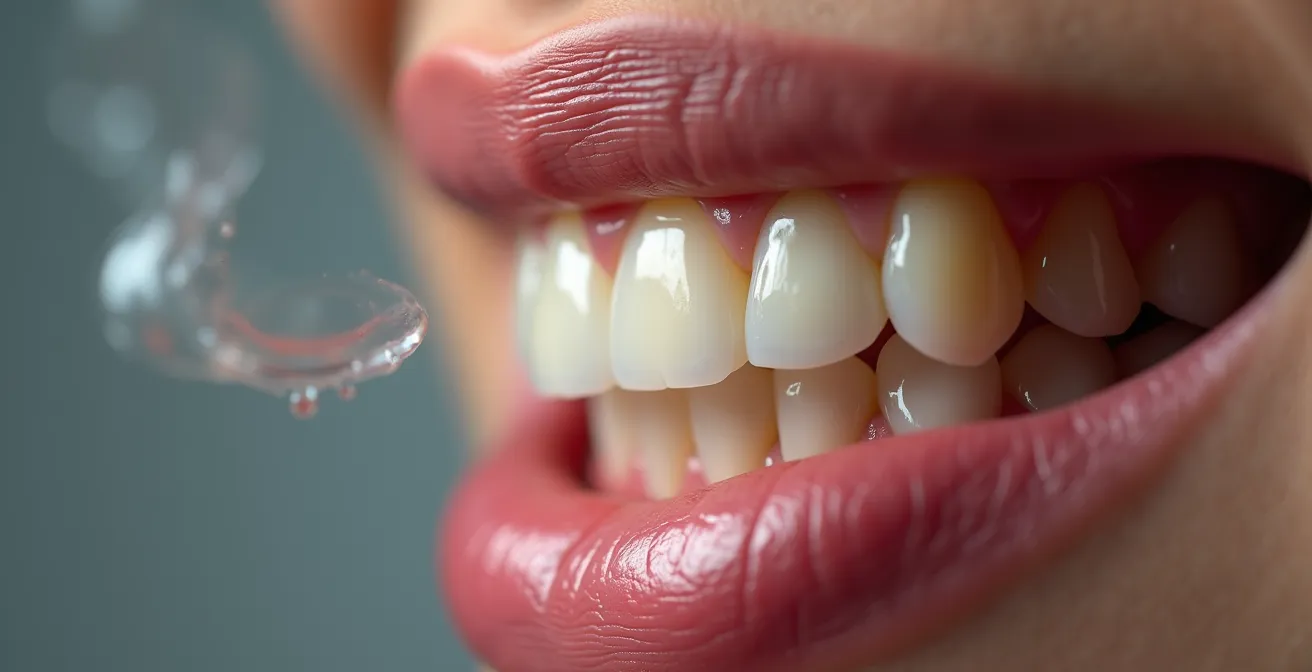
The image above illustrates the moment of control. The correct technique isn’t just about parking the gum; it’s about adopting a pre-emptive parking strategy. You must stop chewing and park the gum *before* the tingle becomes intense and your mouth fills with saliva. By parking it high on the upper gum, you keep it away from the major salivary glands on the floor of your mouth. This minimizes saliva production and gives the nicotine time to absorb through the thin tissue of your cheek lining, delivering it directly to your bloodstream for fast craving relief without any gastric irritation.
How Long Should You Chew One Piece for Full Effect?
A common point of confusion is how long a single piece of nicotine gum lasts. Unlike regular chewing gum, which you might chew for hours, nicotine gum has a finite lifespan for effectiveness. The nicotine in a single piece is typically depleted after about 30 minutes of proper use. MedlinePlus notes that this is the typical time until the peppery taste and tingling sensation completely subside, indicating that the nicotine has been fully released and absorbed.
However, “30 minutes” doesn’t mean you should be chewing continuously for that entire period. The duration is dictated by your chewing pattern, which you can adapt based on your needs. The two primary strategies are “Front-Loading” for intense, sudden cravings, and “Sustained Release” for managing general, background urges throughout the day. A third, “Reactivation,” can be used to get a little more out of a piece you’ve had parked for a while.
The following table breaks down these strategies to help you tailor your use for maximum effect. Choosing the right pattern depends entirely on the type of craving you are trying to manage.
| Strategy | Chewing Pattern | Duration | Best For |
|---|---|---|---|
| Front-Loading | More chewing initially (first 10 min) | 20-25 minutes total | Intense sudden cravings |
| Sustained Release | Minimal chewing, more parking | 30 minutes total | Managing background urges |
| Reactivation | 2-3 small chews after extended parking | Additional 5-10 minutes | Minor end-of-day urges |
For most users, the Sustained Release strategy is the most effective for all-day management. It provides a steady, low dose of nicotine that keeps background cravings at bay without causing side effects. Front-loading should be reserved for those emergency moments when you feel an overwhelming urge to smoke. By understanding these patterns, you can use the gum more strategically, ensuring you get the right amount of nicotine when you need it most.
The Mistake of Drinking Coffee While Chewing Nicotine Gum
Many smokers associate coffee with cigarettes, so it’s natural to reach for nicotine gum while having a morning cup. This is a critical mistake that renders the gum almost completely ineffective. The problem isn’t the coffee itself, but its acidity. Nicotine from NRT products is absorbed best in a neutral or slightly alkaline environment (a neutral pH). Acidic substances drastically lower the pH in your mouth, which prevents the nicotine from being absorbed through the buccal mucosa.
When you drink coffee and then immediately chew the gum, you are essentially washing the nicotine away before your body can use it. You’ll get the taste, but very little of the active ingredient will enter your bloodstream. This leads to continued cravings, and you may mistakenly believe the gum isn’t strong enough. In reality, you’ve simply created an environment where it cannot work. This effect isn’t limited to coffee. Quit-smoking programs warn of “stealth acidity” in many common beverages. The list of drinks to avoid 15 minutes before and during gum use includes:
- All sodas (including diet and sugar-free versions)
- Fruit juices (orange, apple, etc.)
- Sports drinks
- Wine and beer
- Kombucha and other fermented drinks
- Tomato-based beverages
To ensure success, you must separate your acidic beverage habit from your nicotine gum use. Water is the only truly safe beverage to drink while using the gum. For coffee lovers, this requires a simple but strict timetable.
- Finish Your Coffee: Drink your entire coffee, tea, or soda first.
- Rinse Thoroughly: Rinse your mouth out with plain water to wash away acidic residue.
- Wait 15 Minutes: Set a timer and wait for a full 15 minutes. This allows the pH in your mouth to return to a neutral state.
- Begin Chewing: Only now should you start using your nicotine gum with the proper “Park and Chew” method.
- Avoid Acidic Drinks: Do not consume any other acidic beverages for the entire 30-minute duration of the gum.
Gum vs Lozenge: Which Is More Discreet for Meetings?
For many, the workplace is a major trigger for cravings, but using NRT in a professional setting like a meeting requires discretion. Both nicotine gum and lozenges are effective, but they have different pros and cons when it comes to being unnoticeable. The choice between them often comes down to balancing visibility, speech impact, and noise.
Nicotine gum, when used correctly with the “Park and Chew” method, can be completely invisible. Once parked high on the upper gum, it’s out of sight. Since you are not actively chewing, your jaw isn’t moving, and speech impact is minimal. The only giveaway is the initial few chews needed to start the nicotine release, which might be audible in a very quiet room. If you can do this before the meeting starts, the gum becomes the more discreet option for the duration.
Nicotine lozenges, on the other hand, are completely silent to use. You simply place one in your mouth and let it dissolve. However, the lozenge itself can be a challenge. It needs to be moved around occasionally to avoid irritating one spot, and depending on its position, it can cause a slight lisp or slur, which is not ideal if you need to speak clearly. While a “mini” lozenge is less obtrusive, it might still be slightly visible under the tongue or in the cheek pouch.
The following decision matrix can help you choose the best option based on the specific demands of your professional environment.
| Factor | Nicotine Gum | Nicotine Lozenge | Winner |
|---|---|---|---|
| Visibility when parked | Invisible if parked high on upper gum | Slightly visible under tongue | Gum |
| Speech impact | Minimal if parked correctly | Can cause lisp or slurring | Gum |
| Silent use | Initial chewing audible | Completely silent | Lozenge |
| Duration | 30 minutes | 20-30 minutes | Tie |
Using a Straw to Mimic the Drag of a Cigarette
Quitting smoking is more than just overcoming a chemical dependency; it’s also about breaking a powerful set of behavioral rituals. The hand-to-mouth motion, the sensation of “drag” on the inhale, and the rhythmic nature of the act are deeply ingrained habits. Nicotine gum addresses the chemical craving, but it does nothing to satisfy this ritualistic, or “tactile,” component. This is a major reason why many people struggle, as they miss the physical act of smoking.
An incredibly effective and simple technique to address this is using a straw. The act of bringing a straw to your lips and inhaling air through it closely mimics the physical sensation and “drag” of a cigarette. It provides a powerful sensory replacement that satisfies the hand-to-mouth habit. This isn’t just a folksy tip; it’s a form of behavioral replacement therapy. When you combine this physical action with the chemical support of nicotine gum, you are tackling the addiction from both angles. A Cochrane review found there is a 50-60% increase in quit rates when NRT is combined with behavioral techniques like this one.
To make this even more effective, you can use a “sensory stacking” method to create a more complete simulation of the smoking experience. This involves layering several sensory inputs to satisfy different aspects of the old habit.
- Chemical Component: Use nicotine gum (or another NRT) correctly to manage the chemical craving.
- Tactile Component: Use a straw (a cold metal straw kept in the freezer is especially effective) to replicate the hand-to-mouth motion and drag.
- Respiratory Component: As you “drag” on the straw, practice a slow, deliberate breathing pattern like box breathing (inhale for 4 seconds, hold for 4, exhale for 4, hold for 4). This mimics the controlled breathing of smoking and also calms the nervous system.
- Sensory Enhancement: Sip ice water between straw drags. The cold sensation in your throat can provide a satisfying “hit” that further distracts from the desire for smoke.
The Mistake of Chewing Soft Candy vs Crunchy Veggies
When smokers quit, they often look for something to replace the oral fixation—the need to have something in their mouth. The common go-to is often soft candy, sugary gum, or other sweets. This is a significant mistake that can inadvertently sabotage a quit attempt. While it seems to satisfy the oral fixation, it creates a new problem: blood sugar spikes and crashes. The crash often manifests as irritability, anxiety, and a feeling of fogginess—symptoms that are easily mistaken for nicotine cravings, creating a vicious cycle where you reach for more sugar, thinking you need to fight a craving.
The far better alternative is to choose crunchy, healthy foods like raw vegetables. The reason this works so well goes beyond just being a healthier choice; it’s rooted in neuroscience. The auditory feedback from a loud “crunch” provides a much more satisfying sensory experience than chewing something soft.
The Neuroscience of the “Crunch”
Research on oral fixation replacement shows that the combination of jaw pressure and the loud, sharp sound produced by crunching on foods like carrots or celery sticks activates neural pathways in the brain that are more satisfying and release more dopamine than chewing soft textures. This sensory combination provides a gratifying “punctuation” to the act of eating, similar to the ritualistic punctuation that smoking provides. This powerful feedback loop helps satisfy the brain’s need for a sensory reward, making it a superior replacement for the oral fixation component of smoking.
Building an “oral fixation toolkit” with a variety of textures, temperatures, and flavors can keep things interesting and prevent you from falling back on sugar. This toolkit should be portable and ready for when a craving strikes.
- Crunchy Options: Baby carrots, celery sticks, apple slices, raw almonds, or sunflower seeds (in the shell, as the act of shelling them also keeps hands busy).
- Chewy Alternatives: Sugar-free jerky or unsweetened dried mango strips.
- Cold Sensations: Frozen grapes, frozen berries, or simple ice chips.
- Textural Variety: Sugar-free hard mints or cinnamon sticks.
Key Takeaways
- Nicotine gum is a medical tool, not candy. Side effects are almost always due to improper technique (chewing too fast and swallowing).
- The “Park and Chew” method is essential: chew a few times until you feel a tingle, then park the gum between your cheek and gum until the tingle fades.
- Your mouth’s pH is critical. Avoid acidic drinks like coffee, soda, and juice for 15 minutes before and during use to ensure proper nicotine absorption.
Nicotine Lozenges: How to Manage Urges in Non-Smoking Offices?
Nicotine lozenges are an excellent, highly discreet option for managing cravings in environments where you can’t smoke or vape, such as a non-smoking office. Because they are completely silent and require no chewing, they are often less obtrusive than gum. However, to use them effectively without impacting your professionalism, you need a clear strategy, particularly for managing stress-induced urges during meetings or high-pressure work periods.
The most effective approach is a pre-emptive dosing strategy. Instead of waiting for a powerful craving to strike in the middle of a presentation, you anticipate it. If you know that a certain weekly meeting or a looming deadline is a trigger, use a lozenge 15 minutes *before* the event begins. This ensures that the nicotine is already in your system, taking the edge off before the craving even has a chance to build. This proactive approach gives you a sense of control and prevents you from being distracted by withdrawal symptoms when you need to be focused.
Speech clarity is another major concern in an office setting. A full-sized lozenge can be bulky and may cause a noticeable lisp. To manage this, proper positioning is key. Placing the lozenge flat under your tongue or in the far cheek pouch (between your cheek and upper molars) minimizes its interference with your tongue’s movement, allowing for clearer speech. For very long meetings, some users employ a “cut-and-carry” technique, cutting a lozenge into quarters and using smaller pieces as needed to maintain a steady but low-profile dose. This combination of pre-emptive use and strategic positioning makes the lozenge an ideal tool for the modern workplace.
By mastering these techniques, you transform NRT from a simple product into a sophisticated tool. The next step is to apply this knowledge consistently, turning these correct methods into your new, healthier habits.