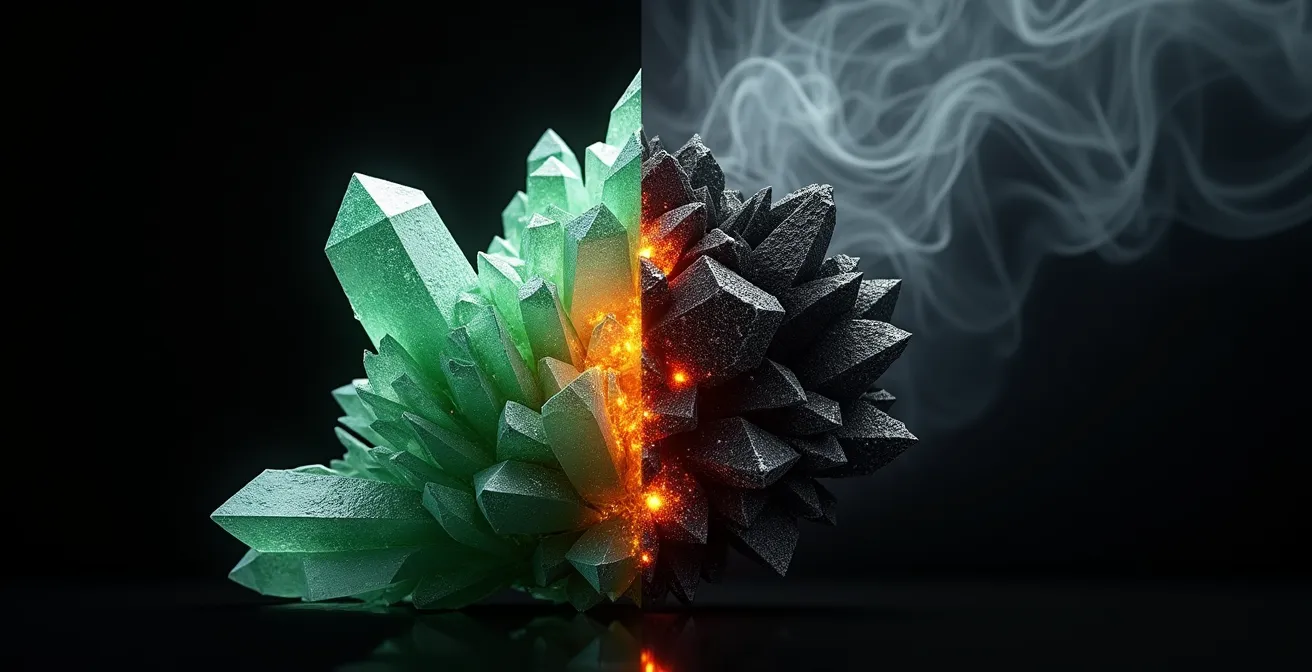
The core danger of smoking doesn’t lie in the nicotine itself, but in the chemical process of combustion. Burning tobacco at extreme temperatures creates thousands of new, toxic compounds that are not present in the original leaf. This article explains the fundamental chemical transformations that make inhaling smoke from a lit cigarette profoundly different and more harmful than using non-combustible nicotine products.
You have likely heard the seemingly contradictory advice from health professionals: cigarettes are lethal, yet nicotine replacement therapies like patches or gums are considered safe tools for quitting. This paradox creates confusion. If nicotine is the common denominator, why is one delivery method so much deadlier than another? The answer isn’t in the substance that causes addiction, but in the violent, uncontrolled chemical reaction that releases it: fire.
Most discussions about smoking risks focus on a list of “bad chemicals” or the addictive nature of nicotine. While true, this misses the fundamental point. The real villain is the process of combustion itself—the act of setting tobacco ablaze. When you light a cigarette, you are initiating a series of high-temperature reactions, a process of thermal decomposition and pyrolysis that transforms the relatively stable tobacco leaf into a complex, toxic aerosol we call smoke.
This article will dissect that process from a toxicologist’s perspective. We will move beyond the simple fact that “smoking is bad” and explore the specific chemistry of why. We will examine the critical temperature thresholds that create carcinogens, the role of additives, the different types of smoke produced, and how the very byproducts of fire impact your body, from immediate fatigue to long-term lung damage. Understanding this distinction is the first step toward making a truly informed decision about your health.
Summary: The Chemistry of Fire: Why Combustion Is the Real Enemy, Not Nicotine
- Why Heating Tobacco Above 800°C Creates New Carcinogens?
- Ammonia and Sugar: How Additives Change the Burn Rate?
- Sidestream vs Mainstream: Which Smoke Is More Toxic?
- The Filter Myth: Why Orange Filters Don’t Block Combustion Toxins?
- The Fire Risk: How Falling Asleep With a Cigarette Changes Lives?
- Why Heating Above 400°C Changes Everything for Your Lungs?
- Why You Feel Tired All Day Despite Sleeping 8 Hours?
- Spirometry Results: What Does FEV1 Mean for Your Recovery?
Why Heating Tobacco Above 800°C Creates New Carcinogens?
The tip of a burning cigarette is a miniature chemical reactor operating at extreme temperatures. During a puff, the heat can surge to over 900°C. At this temperature, the organic matter of the tobacco leaf doesn’t just burn; it undergoes a process called pyrolysis and combustion. This is a violent thermal decomposition where complex organic molecules are shattered and reformed into entirely new, and often highly toxic, substances. The original tobacco leaf simply does not contain the same chemical profile as the smoke it produces.
The science is definitive: this high-temperature transformation is the primary source of harm. Comprehensive research confirms that this process generates a complex aerosol containing thousands of distinct chemical compounds. In fact, over 2,800 toxic compounds are created during combustion that are completely absent in the unburned tobacco plant. These newly formed substances include well-known carcinogens, mutagens, and other toxicants responsible for the vast majority of smoking-related diseases.
This is the fundamental reason why the delivery mechanism is so critical. The harm is not inherent to the tobacco or the nicotine within it, but is a direct consequence of setting it on fire. It is a process of chemical transformation, turning a plant into a factory for toxins, delivered directly to the lungs with every inhalation. Understanding this separates the addictive agent (nicotine) from the agent of disease (the toxicant profile of smoke).
Ammonia and Sugar: How Additives Change the Burn Rate?
The chemical composition of a modern cigarette is not limited to just tobacco. Manufacturers have historically used hundreds of additives, including sugars and ammonia compounds, for various purposes. While often framed as “flavor enhancers,” these additives can have significant effects on the chemistry of combustion and the addictive potential of the cigarette. Sugars, for example, caramelize when burned, which can make the smoke feel smoother and less harsh, encouraging deeper inhalation. However, burning sugar also produces aldehydes, including acetaldehyde, a carcinogen that also enhances the addictive properties of nicotine.
Ammonia compounds serve a different but equally critical function. They raise the alkalinity (pH) of the smoke. This chemical shift converts nicotine from its salt form into its “freebase” form. Freebase nicotine is more volatile and is absorbed much more rapidly and efficiently by the lungs and brain. This creates a more immediate and intense “hit,” reinforcing the addictive cycle more powerfully than nicotine in its natural state.
Even the processing of tobacco before it’s made into a cigarette can create precursors for toxins. For example, the curing and aging process used for some tobacco products leads to high concentrations of nitrogen compounds. When this tobacco is burned, these compounds can give off several tobacco-specific nitrosamines (TSNAs), a potent group of carcinogens. This demonstrates that every step, from processing to additives, can alter the final toxicant profile when combustion is introduced.
Sidestream vs Mainstream: Which Smoke Is More Toxic?
When a cigarette burns, it produces two distinct types of smoke: mainstream and sidestream. Mainstream smoke is what the smoker actively inhales through the filter. Sidestream smoke is the smoke that drifts from the burning tip of the cigarette into the surrounding air. Many people assume they are the same, but from a chemical standpoint, they are significantly different, and sidestream smoke is often more toxic.
This difference is due to the temperature and oxygen conditions under which each is formed. Mainstream smoke is generated at very high temperatures (around 900°C) during a puff, with a relatively limited oxygen supply. Sidestream smoke, however, is formed at lower temperatures (around 400°C) between puffs and with more oxygen. This lower-temperature, oxygen-rich smoldering results in a less complete and more inefficient combustion process. Consequently, it produces higher concentrations of many toxic and carcinogenic compounds, including carbon monoxide and specific N-nitrosamines.
The physical properties also differ. To visualize this, imagine looking at the smoke under a microscope. Sidestream smoke contains a much higher concentration of smaller particles.
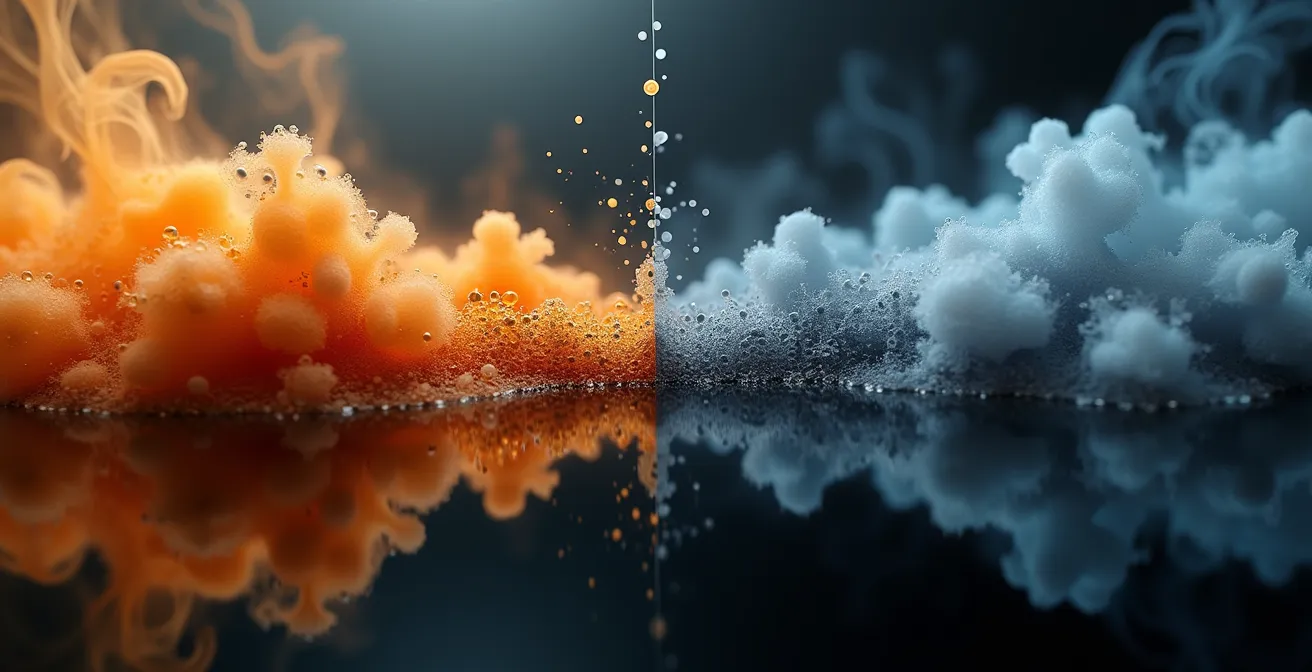
As this visualization suggests, the particle density is immense. Scientific analysis shows that sidestream smoke can contain 10^7 to 10^10 particles per mL, with diameters small enough to penetrate deep into the lungs. This is the scientific basis for the dangers of secondhand smoke; it’s not just diluted mainstream smoke, but a chemically distinct and often more concentrated toxic aerosol.
The Filter Myth: Why Orange Filters Don’t Block Combustion Toxins?
Cigarette filters were introduced in the 1950s and marketed as a safety feature, creating a widespread belief that they make smoking “safer.” This is a dangerous misconception. While a filter can trap some of the larger tar particles (evidenced by the browning of the filter), it is fundamentally ineffective at removing the most dangerous components of cigarette smoke generated by combustion.
The primary reason for this failure is a matter of physics and chemistry. The most harmful products of combustion are not just solid particles; they are a complex mix of gases and extremely fine aerosolized droplets. Gases like carbon monoxide, formaldehyde, and hydrogen cyanide pass through a cellulose acetate filter with virtually no resistance. Furthermore, the smoke contains billions of microscopic liquid and solid particles that are too small to be captured effectively by the filter’s fibers. These are the particles that travel deep into the lung’s alveoli, where they can be absorbed into the bloodstream and cause systemic damage.
A puff of smoke is not a simple substance; it’s a chemical cocktail. According to the National Cancer Institute, each puff contains a mixture of thousands of compounds, including over 60 established carcinogens. This toxic mixture includes polycyclic aromatic hydrocarbons (PAHs), N-nitrosamines, aromatic amines, and toxic metals. The filter does little to stop them. In some cases, filter ventilation holes—designed to dilute the smoke with air—can cause smokers to unconsciously inhale more deeply or more frequently to get the desired nicotine dose, a behavior known as compensatory smoking, which can negate any potential benefit.
The Fire Risk: How Falling Asleep With a Cigarette Changes Lives?
Beyond the internal, chemical dangers of combustion, the act of burning a cigarette carries a significant external physical risk: fire. A lit cigarette is an open flame source, smoldering at several hundred degrees Celsius. When left unattended, particularly near flammable materials like bedding, upholstery, or curtains, it can easily ignite a fire with devastating consequences. Fires started by smoking materials are a leading cause of residential fire-related deaths and injuries worldwide.
The scenario of falling asleep while smoking is particularly tragic and all too common. The combination of exhaustion and the sedative effects of nicotine and other smoke components can lead a person to doze off, dropping the lit cigarette. Within minutes, a mattress or sofa can begin to smolder, releasing highly toxic gases like carbon monoxide and hydrogen cyanide long before flames are visible. Victims often succumb to smoke inhalation in their sleep, never having a chance to escape.
In response to this, regulations in many countries now mandate “Fire-Safe” or “Lower Ignition Propensity” cigarettes. However, it’s critical to understand the limitations of this technology. It does not make cigarettes fire-proof, only less likely to ignite certain materials.
Action Plan: Understanding “Fire-Safe” Cigarette Limitations
- Recognize the technology: FSC cigarettes use bands of less porous paper as ‘speed bumps’ to slow the burn when unattended.
- Acknowledge the limit: This technology reduces, but does not eliminate, the risk of fire.
- Understand the timing: A cigarette will often self-extinguish only after 1-2 minutes of being left alone, providing ample time to start a smoldering fire.
- Consider the chemistry: The additives used in the FSC paper bands may alter the chemistry of the smoke, a factor not fully understood.
- Maintain vigilance: Never leave a lit cigarette unattended, regardless of its design.
Why Heating Above 400°C Changes Everything for Your Lungs?
Now that we’ve examined the extreme dangers of high-temperature burning, let’s focus on the critical temperature threshold where the damage begins. The key to understanding the harm of combustion lies in separating the temperature needed to release nicotine from the temperature at which tobacco begins to burn. This is the scientific foundation for the development of alternative nicotine products.
Nicotine is a relatively volatile substance. It begins to turn into a vapor at around 247°C (477°F). However, the tobacco plant material itself does not begin to burn—to undergo combustion—until it reaches a much higher temperature. Research from PMI Science confirms that tobacco begins to burn at approximately 400°C (752°F). This ~150°C gap is everything. It means it is theoretically possible to heat tobacco enough to release an aerosol containing nicotine without actually burning it and creating smoke.
Crossing the 400°C threshold is the point of no return. Below this temperature, the chemical processes are relatively limited. Above it, the process of combustion kicks in, unleashing the cascade of thermal decomposition and pyrolysis that creates the thousands of toxicants discussed earlier. It is the beginning of the chemical reaction that generates tars, carbon monoxide, and the vast majority of carcinogens found in cigarette smoke.
That’s far below the temperature at which tobacco begins to burn, around 400°C. That means it’s possible to heat tobacco enough to release nicotine without burning it and producing smoke… Below about 400°C, there’s not too much of a difference between the processes that occur in tobacco that’s heated in air with oxygen versus tobacco that’s heated without oxygen.
– PMI Science Research Team, Why We Don’t Need Combustion
Why You Feel Tired All Day Despite Sleeping 8 Hours?
Beyond the long-term risks of cancer and lung disease, the byproducts of combustion have immediate, systemic effects on your body. One of the most common yet often overlooked is chronic fatigue. Many smokers attribute their lethargy to lifestyle or poor sleep, but a primary culprit is a specific gas produced by burning tobacco: carbon monoxide (CO).
To understand why, you need to look at how your body transports oxygen. Red blood cells contain a protein called hemoglobin, which is responsible for picking up oxygen in the lungs and delivering it to every cell in your body, from your brain to your muscles. This process is essential for cellular energy production. However, when you inhale cigarette smoke, you are also inhaling significant amounts of carbon monoxide.
The problem lies in a principle called binding affinity. Hemoglobin is far “stickier” to carbon monoxide than it is to oxygen. In fact, research shows CO binds to hemoglobin over 200 times more strongly than oxygen does. This means that when both are present, CO will preferentially occupy the binding sites on your red blood cells, effectively blocking oxygen from being transported.

This creates a state of systemic, low-level oxygen deprivation, or hypoxia. Your organs, muscles, and brain are being starved of the oxygen they need to function optimally. The result is not acute suffocation, but a persistent feeling of tiredness, sluggishness, and reduced physical and mental stamina, even after a full night’s sleep. Your body is working harder just to meet its basic energy demands.
Key Takeaways
- The primary harm from cigarettes comes from combustion, the act of burning tobacco above 400°C, which creates thousands of new toxins.
- Nicotine is the addictive agent, but it is the toxic byproducts of fire—not the nicotine itself—that cause the vast majority of smoking-related diseases.
- Gases like carbon monoxide, a product of combustion, directly impair the body’s ability to transport oxygen, leading to chronic fatigue and reduced stamina.
Spirometry Results: What Does FEV1 Mean for Your Recovery?
The cumulative damage from years of inhaling combustion byproducts is physically measured through tests like spirometry. A key value from this test is the Forced Expiratory Volume in 1 second (FEV1). This measures how much air you can forcefully exhale from your lungs in a single second. For a healthy individual, this volume is high. For someone whose lungs have been damaged by smoke, it is significantly reduced. A declining FEV1 is a hallmark of Chronic Obstructive Pulmonary Disease (COPD).
FEV1 is a direct indicator of obstruction and inflammation in your airways, caused by the constant irritation from tar, fine particles, and toxic gases. It represents a loss of lung elasticity and the narrowing of bronchial tubes. In the context of recovery, monitoring your FEV1 after you stop inhaling combusted smoke is critical. While some damage, particularly the destruction of alveoli in emphysema, is irreversible, quitting can halt the accelerated decline of your FEV1. In many cases, the inflammation can subside, leading to a noticeable improvement in this value and your ability to breathe.
Interestingly, the nature of lung damage has evolved over the decades. Data from the National Cancer Institute shows that since the 1960s, a smoker’s risk of developing lung cancer or COPD has increased compared to nonsmokers, even as the average number of cigarettes smoked has decreased. There has also been a dramatic shift in the type of lung cancer, with a rise in adenocarcinomas, which develop in the outer parts of the lungs. This suggests changes in cigarette design and composition may have altered how the toxic smoke is delivered and where the damage occurs, but the fundamental link to combustion remains. FEV1 is your personal metric for tracking the damage and the potential for recovery once combustion is removed from the equation.
Ultimately, the entire conversation about the risks of smoking must pivot away from a singular focus on nicotine and toward a clear-eyed understanding of combustion. By separating the addictive substance from the profoundly toxic delivery system, you can make more informed decisions. The path to improved health starts with extinguishing the fire. For a personalized assessment of your lung health and a plan to stop your exposure to combustion, consulting with a healthcare professional is the most logical next step.