You probably believe that if you were having heart problems, you’d feel it—typically as chest pain. This is a dangerous misconception. Smoking systematically sabotages your body’s internal alarm systems, creating a state of physiological deception. This article reveals the invisible, moment-by-moment damage occurring inside your arteries, making the abstract risk of a “silent” heart attack a tangible reality you can no longer afford to ignore.
As a smoker, you likely rationalize the risk. You feel fine, you don’t have shortness of breath, and most importantly, you don’t have chest pain. This absence of symptoms is often misinterpreted as an absence of disease. This is the most dangerous illusion for a long-term smoker. The human body has an incredible capacity to adapt and function despite ongoing damage, but this resilience has a limit. The problem with smoking-related heart disease is that it is often a silent cascade of destruction, dismantling your cardiovascular system from the inside out without sending the usual distress signals.
Most health advice focuses on the obvious: plaque buildup, high blood pressure, and the eventual risk of a heart attack. But it fails to address the most terrifying question: why don’t you *feel* it happening? The answer lies in the insidious nature of the chemicals you inhale. They don’t just damage your arteries; they actively suppress and corrupt the very mechanisms that would normally warn you of danger. You are not just a person at risk; you are flying a plane with the emergency alarms deliberately disabled.
This is not about scaring you with abstract statistics. This is about pulling back the curtain on the specific, physiological events that are happening in your body with every cigarette. We will move beyond the generic warnings and dissect the tangible processes: how your blood thickens, why your arteries harden, and how soft, vulnerable plaque forms a ticking time bomb in your circulation. Understanding this silent sabotage is the first, most critical step toward recognizing that “feeling fine” is not a sign of health, but a symptom of a much deeper problem.
This article will guide you through the hidden mechanics of smoking-induced silent ischemia. By understanding these processes, you will gain a new perspective on your health and the urgent need for action.
Summary: Silent Ischemia: Uncovering the Hidden Heart Damage from Smoking
- Cold Hands and Feet: Is Smoking Closing Your Extremity Arteries?
- Soft Plaque vs Hard Plaque: The Ticking Time Bomb in Smokers
- How Smoking Oxidizes LDL Cholesterol and Hardens Arteries?
- The Danger of the Post-Meal Cigarette for Heart Strain
- How Smoking Thickens Your Blood Instantly and Causes Clots?
- Why Nicotine Actually Increases Your Resting Heart Rate?
- The 15-Year Milestone: When Does Your Heart Risk Equal a Non-Smoker?
- Reducing Heart Attack Risk: The Timeline for Smokers Over 50
Cold Hands and Feet: Is Smoking Closing Your Extremity Arteries?
One of the first, most dismissed signs of cardiovascular damage isn’t in your chest, but at the very tips of your fingers and toes. If you constantly have cold hands and feet, it’s not just “poor circulation”; it’s a direct warning sign of vasoconstriction, a process where your blood vessels clamp down. Nicotine is a powerful vasoconstrictor. With every puff, it triggers a hormonal cascade that signals the smooth muscles in your artery walls to contract, forcibly narrowing the passages your blood flows through. This effect is most pronounced in your smallest, most distant arteries—the ones supplying your extremities.
This isn’t a minor inconvenience. It’s a symptom of Peripheral Artery Disease (PAD), a condition where plaque buildup and arterial narrowing starve your limbs of oxygen-rich blood. The link is undeniable; staggering research shows that 80% of PAD patients are current or former smokers. Your cold extremities are a physical manifestation of this systemic arterial shutdown. The body is trying to send a signal from its furthest outposts that the supply lines are being squeezed shut. Ignoring this is like ignoring the flickering lights in a building right before a total power failure.
The mechanism is a form of vascular sabotage. Nicotine reduces the availability of nitric oxide (NO), a crucial molecule that tells your arteries to relax and dilate. Without enough NO, your arteries remain in a state of chronic tension. Over time, this constant constriction damages the delicate inner lining of the arteries (the endothelium), creating a rough, inflamed surface that becomes a perfect breeding ground for the plaque that causes heart attacks and strokes. So, the next time you feel that chill in your hands, understand it’s a distress signal from the front lines of a war being waged inside your blood vessels.
Soft Plaque vs Hard Plaque: The Ticking Time Bomb in Smokers
Not all arterial plaque is created equal. Many people imagine plaque as a hard, stable, calcified substance that slowly clogs an artery over decades, like scale in a pipe. This is “hard plaque,” and while it’s certainly not good, it’s not the primary culprit in most smoking-related heart attacks. The real killer is its volatile cousin: soft, vulnerable plaque. Think of hard plaque as a concrete barrier and soft plaque as a pus-filled abscess on the artery wall, covered by a thin, fragile cap.
Smoking is a primary driver in the formation of this dangerous soft plaque. The toxic chemicals in cigarette smoke, particularly carbon monoxide and free radicals, trigger a massive inflammatory response in the arterial walls. Your immune system sends white blood cells (macrophages) to clean up the damage, but they become overwhelmed by oxidized cholesterol, transforming into “foam cells.” These foam cells are the core components of soft plaque, forming a lipid-rich, inflamed, and unstable mass just beneath the artery’s lining.
This visual below illustrates the critical difference. The stable, hard plaque is a fixed obstruction. The soft, vulnerable plaque is an active, inflamed lesion poised to rupture.
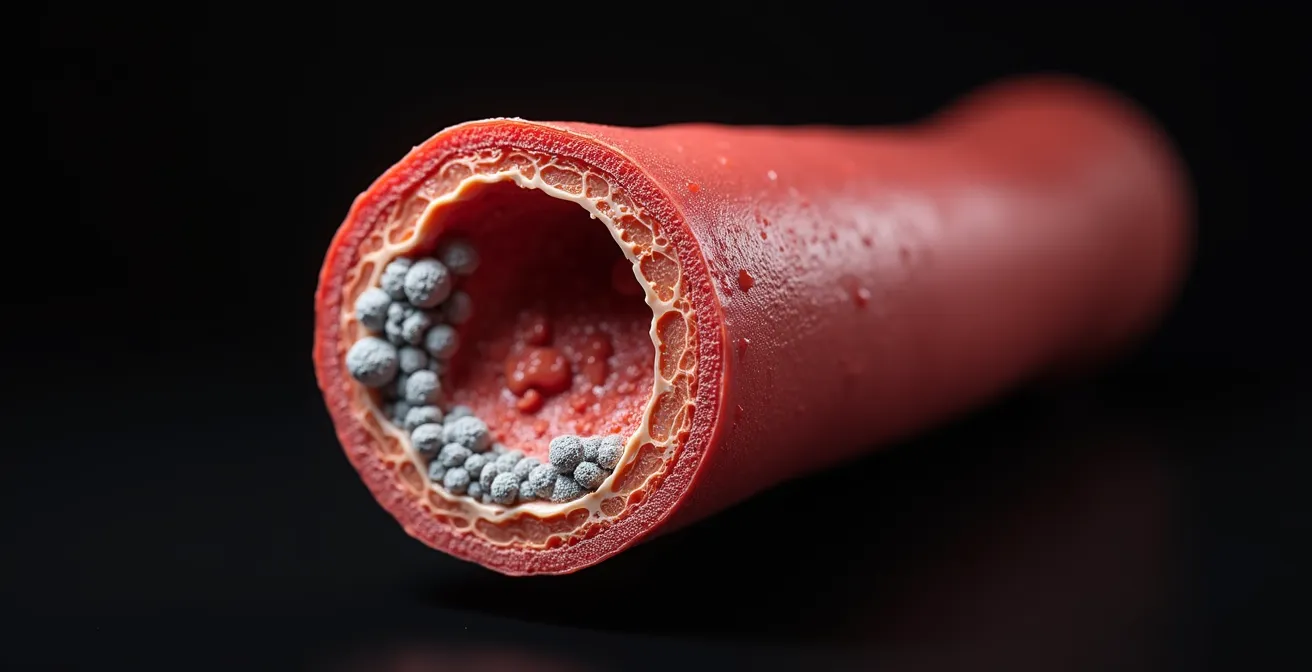
The thin fibrous cap covering this soft plaque is constantly being weakened by inflammatory enzymes that are overproduced in smokers. A sudden spike in blood pressure or heart rate—something that happens every time you light a cigarette—can be enough to tear this cap. When it ruptures, the fatty core is exposed to the bloodstream, and the body’s clotting system mistakes it for a major injury. It forms a massive blood clot on the spot, one large enough to completely block the artery and trigger a catastrophic heart attack or stroke. This is the “ticking time bomb” that explains why seemingly “healthy” smokers can have a sudden, fatal cardiac event without warning.
How Smoking Oxidizes LDL Cholesterol and Hardens Arteries?
The term “high cholesterol” is often thrown around, but the nuance is critical for a smoker. It’s not the amount of LDL (Low-Density Lipoprotein) cholesterol in your blood that’s the sole problem; it’s what smoking *does* to that cholesterol. The free radicals in cigarette smoke—highly unstable molecules—initiate a process called oxidation. They essentially “steal” electrons from LDL particles, chemically altering them. This oxidized LDL is the true villain in the story of atherosclerosis, or arterial hardening.
Your body’s cells have receptors to recognize and process normal LDL cholesterol. But they do not recognize oxidized LDL. Instead, the immune system views it as a foreign invader, like a bacterium or virus. This triggers the silent cascade of inflammation we discussed. Macrophages rush in to consume the oxidized LDL, become foam cells, and burrow into the artery wall, initiating the formation of soft plaque. This process is a direct chemical consequence of inhaling smoke. You are, in effect, force-feeding your arteries a substance your body is programmed to attack.
This oxidation chain reaction is a relentless process that turns your own cholesterol into an arterial weapon:
- Free radicals from inhaled smoke enter the bloodstream directly.
- These radicals steal electrons from LDL cholesterol particles, oxidizing them.
- Oxidized LDL becomes unrecognizable to the body’s normal receptors.
- The immune system treats oxidized LDL as a foreign invader, triggering a macrophage response.
- Macrophages engulf the oxidized LDL, becoming foam cells that form the core of the plaque.
Simultaneously, nicotine itself contributes to arterial hardening. It directly causes the Vascular Smooth Muscle Cells (VSMCs) in your artery walls to change their function. Instead of maintaining flexibility, they begin producing a stiff, fibrous matrix, making the artery wall rigid and less able to adapt to changes in blood flow. This dual assault—oxidized cholesterol building plaque from within and nicotine hardening the artery wall itself—is how smoking systematically destroys your vascular flexibility, paving the way for silent ischemia.
The Danger of the Post-Meal Cigarette for Heart Strain
The ritual of a cigarette after a meal is one of the most dangerous habits for your heart. Immediately after you eat, your body diverts a significant amount of blood to your digestive system to process the food. This means your heart is already working harder to pump blood to your gut while maintaining adequate flow to the rest of your body. Introducing nicotine at this precise moment places a double burden on your cardiovascular system.
First, the nicotine causes an immediate spike in your heart rate and blood pressure. Your heart is forced to beat faster and harder against arteries that are simultaneously being constricted. Second, and more critically, smoking at this time can induce coronary artery spasms. As the Mayo Clinic warns about myocardial ischemia:
Smoking causes the coronary arteries to spasm and may also increase the risk of blood clots
– Mayo Clinic, Mayo Clinic – Myocardial Ischemia
A coronary artery spasm is a temporary, sudden narrowing of one of the arteries that supplies blood directly to your heart muscle. When this happens, blood flow to the heart is momentarily cut off or severely reduced. If you have pre-existing, non-obstructive plaque, this spasm can be the event that triggers a heart attack. You won’t feel it as a dramatic event, but inside, your heart muscle is being starved of oxygen. This is a classic mechanism of silent ischemia. The post-meal cigarette is not a moment of relaxation; it’s an acute stress test you are forcing your heart to endure multiple times a day. This repeated strain accelerates wear and tear, contributing to the overall disease burden that CDC data reveals increases the risk for coronary heart disease by 2 to 4 times in smokers.
How Smoking Thickens Your Blood Instantly and Causes Clots?
The damage from smoking is not just a long-term process; it is also immediate. Within minutes of inhaling cigarette smoke, the physical properties of your blood change for the worse. The carbon monoxide from the smoke binds to your red blood cells, reducing their ability to carry oxygen. To compensate, your body produces more red blood cells, making your blood literally thicker and more viscous. This increased blood viscosity forces your heart to work significantly harder to pump this sludgy fluid through your already-narrowing arteries.
Simultaneously, smoking makes your blood “stickier.” It damages the lining of your blood vessels and makes the platelets—the tiny cells responsible for clotting—hyperactive and more likely to clump together. As the CDC’s research highlights, this effect is incredibly potent; even briefly breathing secondhand smoke can damage the lining of blood vessels and cause your blood to become stickier. For an active smoker, this means your blood is constantly primed to form clots.
This side-by-side visualization shows the stark contrast. On the left, normal blood flows freely. On the right, the blood of a smoker is visibly thicker and prone to aggregation, a perfect setup for a thrombotic event.

This combination of thick, viscous blood and hyperactive platelets is a recipe for disaster. Imagine this sludgy fluid trying to navigate through an artery already narrowed by vulnerable plaque. All it takes is a small plaque rupture for these over-eager platelets to form an aggressive clot (a thrombus) that completely blocks the vessel. This is thrombosis, the final event that causes most heart attacks and strokes. It’s not a gradual blockage; it’s a sudden, catastrophic plug formed by blood that has been chemically altered to be thicker and stickier. This is an immediate, physiological change happening with every cigarette.
Why Nicotine Actually Increases Your Resting Heart Rate?
Your resting heart rate is a fundamental indicator of your heart’s efficiency. A lower resting heart rate generally means your heart muscle is in good condition and doesn’t have to work as hard to circulate blood. Nicotine systematically destroys this efficiency. As a powerful stimulant, it directly triggers the release of catecholamines like adrenaline, the body’s “fight or flight” hormone. This puts your heart in a constant state of low-grade stress.
Even when you are sitting still, the nicotine in your system keeps your heart beating faster than it should. This elevated resting heart rate means your heart muscle is working overtime, 24/7. Think of it like running a car engine at 3,000 RPM at all times, even when it’s parked. This constant workload leads to hypertrophy, where the heart muscle thickens in an unhealthy way, demanding more oxygen for itself. This creates a dangerous paradox: your over-worked heart needs more oxygen, but your smoking habit is simultaneously reducing the oxygen supply via carbon monoxide and narrowing the coronary arteries that deliver it.
This chronic over-stimulation is a significant independent risk factor. It acts synergistically with other risks like high cholesterol and high blood pressure, multiplying their damaging effects. The American Heart Association has stated that smoking is a major cause of coronary heart disease, which can lead to a heart attack. This isn’t just a statistical correlation; it’s a direct cause-and-effect relationship driven by the relentless strain nicotine places on your heart muscle. That feeling you might interpret as a “lift” or “buzz” from a cigarette is, at a physiological level, the sound of a whip cracking over your heart, forcing it to work harder and wear out faster.
The 15-Year Milestone: When Does Your Heart Risk Equal a Non-Smoker?
While the damage from smoking is severe and immediate, the body’s capacity for healing is remarkable—if given the chance. Quitting smoking is the single most effective action you can take to reverse the silent damage. The timeline for cardiovascular recovery begins almost immediately, but achieving the risk level of a lifelong non-smoker is a long-term journey.
The improvements happen in stages. Within the first year of quitting, the acute effects begin to reverse. Your blood becomes less sticky, the inflammation in your arteries starts to subside, and the risk of a sudden, clot-induced heart attack begins to fall. In fact, according to CDC cardiovascular health data, after just 1 to 2 years of quitting, your risk of a heart attack drops sharply. This is a significant and rapid improvement, driven by the cessation of the constant chemical assault on your vascular system.
The journey continues over several years. After 3 to 6 years, the added risk of coronary heart disease drops by approximately half. Your arterial lining (the endothelium) has had time to heal, restoring its function and reducing the likelihood of new plaque formation. However, the existing plaque, especially the hardened, calcified type, may not disappear entirely. The goal is to render it stable and prevent new, volatile soft plaques from forming.
The ultimate milestone often cited by health organizations is around 15 years. After a decade and a half without smoking, your risk of coronary heart disease approaches that of someone who has never smoked. This demonstrates the profound, long-lasting damage smoking causes, but it also offers a powerful message of hope. It is a long road, but it is a road that leads back to cardiovascular health. Every day without a cigarette is a day your body is actively working to dismantle the silent damage and rebuild its defenses.
Key Takeaways
- “Feeling fine” is a dangerous illusion; smoking disables the body’s pain signals, leading to silent ischemia.
- Smoking causes vasoconstriction (felt as cold hands/feet), creates volatile soft plaque, and instantly thickens your blood, priming it for clots.
- Quitting provides immediate benefits, with heart attack risk dropping sharply after 1-2 years and normalizing around the 15-year mark.
Reducing Heart Attack Risk: The Timeline for Smokers Over 50
For smokers over the age of 50, the risks are amplified. Decades of smoking have likely created a significant burden of atherosclerosis, and the natural aging process makes arteries stiffer and more susceptible to damage. The prevalence of silent ischemia is particularly high in this demographic. In fact, the American Heart Association estimates that as many as 3 to 4 million Americans have episodes of silent ischemia, with the risk being especially high for those with long-standing risk factors like smoking. The absence of chest pain is not reassurance; it is a red flag that your body’s warning system has failed.
However, it is never too late to take decisive action. For this age group, quitting smoking must be combined with proactive medical screening to understand the true extent of the invisible damage. You cannot afford to wait for symptoms to appear. You must go looking for the disease with the help of your physician. This means moving beyond a standard cholesterol test and asking for advanced diagnostics that can reveal the silent threat lurking in your arteries. A proactive stance is your best defense against a sudden cardiac event.
The conversation with your doctor needs to be specific and informed. You are no longer just managing “risk factors”; you are actively hunting for established, but silent, disease. Arm yourself with the right questions to ensure you get the comprehensive evaluation you need.
Your Proactive Conversation Checklist with Your Doctor
- Request a Coronary Artery Calcium (CAC) score test to assess plaque buildup.
- Ask about stress testing (e.g., a treadmill test or nuclear stress test) to uncover silent ischemia.
- Discuss advanced lipid panels that include markers like Lp(a) and ApoB to better assess plaque risk.
- Review all your cardiovascular risk factors and how they interact with your smoking history.
- Create a personalized smoking cessation plan that includes medical support like medication or counseling.
- Schedule regular follow-ups to monitor cardiovascular improvements after you quit.
Take this checklist to your next doctor’s appointment. It is not an act of hypochondria; it is the responsible action of someone who understands that the absence of pain is not the absence of problems. Begin the process of uncovering the truth about your cardiovascular health today.