Contrary to the belief that quitting smoking is an endless battle of willpower, it’s a predictable, 90-day neurological recalibration process. The intense cravings and anxiety you feel aren’t a sign of weakness; they are the audible ‘screams’ of a brain rewiring itself. Understanding this fascinating journey of receptor healing is the key to navigating it successfully and achieving lasting freedom from nicotine.
The decision to quit smoking is often framed as a grueling test of willpower, a fight against an insatiable craving. But what if we’ve been looking at it all wrong? What if the struggle isn’t a character flaw, but a predictable, observable, and ultimately temporary process of neurological repair? For decades, the advice has been to “just get through it,” focusing on the symptoms of withdrawal like irritability and anxiety. We’re told to find distractions, chew gum, and simply endure the discomfort until it, hopefully, passes.
But this approach ignores the incredible science happening inside your head. The real story is not one of deprivation, but of reclamation. It’s about synaptic plasticity, receptor down-regulation, and the brain’s remarkable ability to heal itself. The key to successfully quitting isn’t just resisting a cigarette; it’s understanding the precise, three-month journey your brain undertakes to reset its chemical balance. By viewing this period not as a battle but as a fascinating recalibration project, you can transform your experience from one of suffering to one of empowered observation.
This article will guide you through that neurological journey. We will explore how your brain heals naturally, decode the intense withdrawal symptoms at their chemical source, and explain why a single puff can undo weeks of progress. We will demystify the stress-relief myth and provide you with a practical roadmap for rebuilding your brain’s reward system, one dopamine-rich experience at a time.
To navigate this in-depth exploration of your brain’s recovery, the following summary outlines the key stages and concepts we will cover. Each section builds upon the last, creating a complete picture of the 90-day neurological reset.
Summary: The Neurological Path to a Nicotine-Free Brain
- How to Speed Up Receptor Healing Without Medication?
- Why Your Dying Receptors Cause Anxiety Spikes at 3 Weeks?
- Agonists vs Antagonists: How Chantix Tricks Your Receptors?
- The Critical Window: When Do Receptors Finally Stop Screaming?
- Why One Cigarette Reawakens Dormant Receptors Instantly?
- The 21-Day Chemical Exit: What Happens to Your Body Each Week?
- The Error of Believing Smoking Solves Stress
- Replacing the Dopamine Hit: 5 Natural Ways to Feel Good Without Smoking
How to Speed Up Receptor Healing Without Medication?
The most powerful tool in your brain’s recovery is its own innate ability to heal, a concept known as synaptic plasticity. When you smoke, your brain adapts to the constant flood of nicotine by growing an abnormally high number of nicotinic acetylcholine receptors (nAChRs). This “up-regulation” is the biological root of your dependence. When you quit, the most crucial step you can take is to give your brain what it needs most: a complete and total absence of nicotine. Without its artificial stimulant, the brain begins the slow but steady process of dismantling these extra receptors and re-sensitizing the remaining ones.
This isn’t a theoretical process; it’s observable. As the experts at Allen Carr’s Easyway explain, the evidence is clear:
The brain is a plastic, dynamic organ—it can heal. But it needs one thing: freedom from nicotine. Brain imaging studies show that after quitting smoking, dopamine receptor function begins to normalise within weeks, and structural changes begin to reverse within months to years.
– Allen Carr’s Easyway, How does nicotine affect the brain?
The timeline for this natural healing is surprisingly consistent. While the initial withdrawal is intense, the underlying neurological repair is already underway. Research published in Biological Psychiatry confirms that smoking-related deficits in brain dopamine return to normal three months after quitting. This 90-day window is the critical period where your brain works tirelessly to re-establish its natural dopamine baseline. Speeding up this process isn’t about a magic pill; it’s about rigorously protecting this nicotine-free environment to allow your brain’s natural healing mechanisms to work uninterrupted.
Why Your Dying Receptors Cause Anxiety Spikes at 3 Weeks?
The intense wave of anxiety, irritability, and restlessness that many experience around the first week—and which can fluctuate for up to three or four weeks—is not a psychological failure. It is a physical event. You are feeling the “scream” of billions of down-regulating nicotine receptors. These receptors, which were artificially maintained by a constant supply of nicotine, are now empty and sending frantic signals throughout your brain. This neurological chaos is the direct cause of withdrawal’s emotional turmoil.
This process has a predictable peak. As your body purges the last traces of nicotine, the receptors’ signaling becomes most desperate. According to medical experts, anxiety starts to rise around day 3, with the first week being the worst as nicotine finally clears out. This isn’t just a feeling; it’s a biochemical storm. The empty receptors trigger a surge in other neurotransmitters, like glutamate, which is associated with stress and anxiety, creating a state of hyper-excitability in the brain.
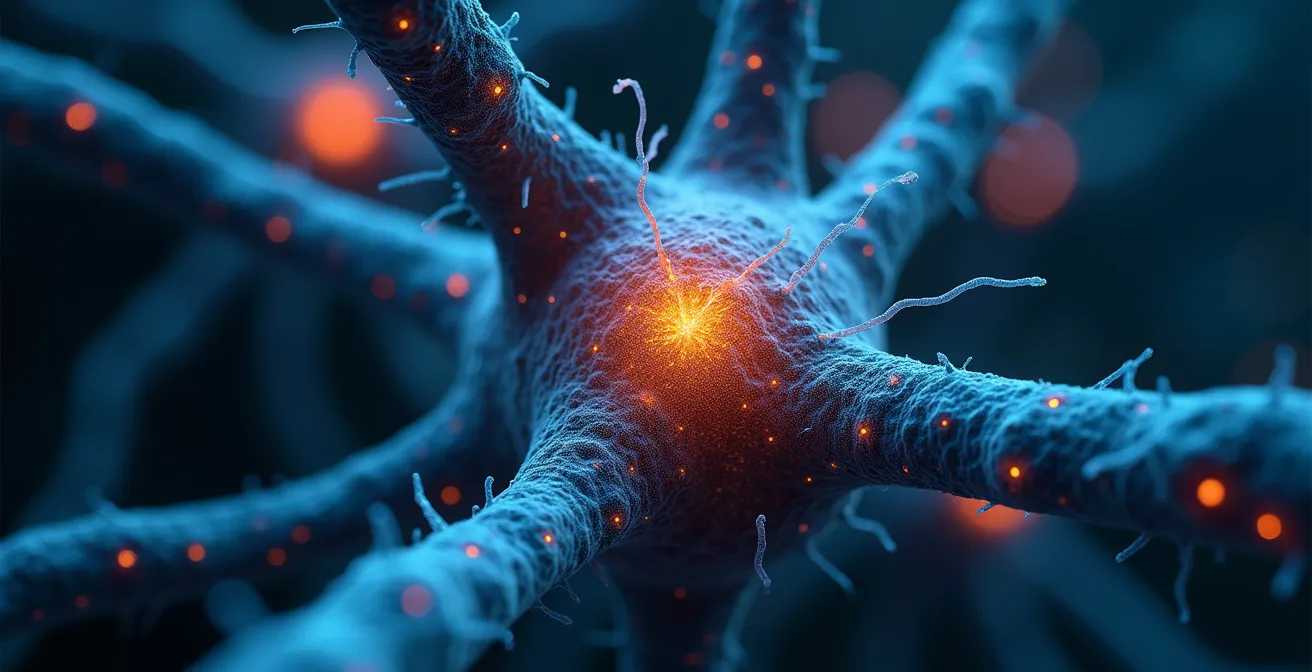
As the image above visualizes, this phase is marked by chaotic electrical activity at a synaptic level. Understanding that this intense anxiety is a temporary, mechanical process can be incredibly empowering. It’s not “you” who is anxious; it is the physical rewiring of your brain manifesting as an emotional state. The receptors are not truly “dying,” but are being pruned back to normal levels. The anxiety spike is a sign that the healing process is working exactly as it should. The “screaming” is the sound of your brain reclaiming its territory.
Agonists vs Antagonists: How Chantix Tricks Your Receptors?
To understand how medications like Varenicline (Chantix) work, you first need to understand the concept of receptor up-regulation. Every time you smoke, nicotine molecules act like a perfect key (an agonist) for your brain’s nicotinic acetylcholine receptors (nAChRs), unlocking a flood of the pleasure-and-reward neurotransmitter, dopamine. Your brain, seeking balance, adapts to this artificial flood by desensitizing the receptors and then building more of them. This creates a state where you need more and more nicotine just to feel “normal.” This is the cellular basis of addiction.
This is where pharmacology intervenes with a clever trick. Varenicline is not a perfect key; it’s a “skeleton key.” It is a partial agonist. This means it fits into the nicotine receptor’s lock, but it doesn’t turn it all the way. It provides just enough stimulation to partially activate the receptor, which releases a small, steady trickle of dopamine. This has two profound effects. First, it significantly reduces the intensity of withdrawal symptoms—the “screaming” of the empty receptors is quieted. Second, because the drug is already occupying the receptor, if you do smoke a cigarette, the nicotine has nowhere to bind. The pleasurable rush is blocked, making the act of smoking unsatisfying.
This dual-action approach can be highly effective. Dr. Licia Syracuse, an Oncologist at Humanitas, reports that studies show 30 to 40% of people taking varenicline can withstand not smoking for up to 52 weeks. The medication essentially acts as a neurological bridge, managing the receptor chaos while you focus on breaking the behavioral habits associated with smoking. It doesn’t heal the brain for you, but it creates a more stable environment in which the brain’s natural healing processes can proceed with less disruption.
The Critical Window: When Do Receptors Finally Stop Screaming?
The first few weeks of quitting can feel like an endless storm, leading to the desperate question: when does it get better? The answer lies in the 90-day critical window of neurological recalibration. While the most acute physical withdrawal symptoms subside within the first month, the deeper work of rewiring the brain’s reward pathways takes longer. The “screaming” of the receptors doesn’t stop overnight; it gradually fades as their numbers return to a normal, pre-smoking baseline.
The timeline for this improvement is becoming increasingly clear through neuroscience research. The most significant and noticeable shifts in mood, impulse control, and emotional regulation occur between the second and third months of abstinence. This is the period when the brain’s dopamine system, which was hijacked by nicotine, starts to function independently again. You begin to find pleasure in everyday activities, and the constant, nagging “background noise” of craving begins to silence.
This isn’t just a subjective feeling; it’s a measurable neurological recovery. According to addiction recovery research, while initial improvements are felt in the first few weeks, the most meaningful improvements often become noticeable by 60-90 days. This is the point where the brain has significantly down-regulated the excess receptors and started to re-establish its natural rhythm. It’s the moment you transition from actively “not smoking” to simply being a “non-smoker.” Knowing this timeline exists provides a crucial light at the end of the tunnel during the toughest early days.
Why One Cigarette Reawakens Dormant Receptors Instantly?
After weeks or months of successful abstinence, the brain has performed a remarkable feat of healing. It has down-regulated the vast surplus of nicotine receptors, and the constant cravings have subsided. The neurological “scream” has faded to a whisper. It’s easy to believe at this point that you’ve “beaten” the addiction and that a single, harmless cigarette won’t hurt. This is a profound and dangerous misunderstanding of brain plasticity.
Those extra receptors don’t vanish entirely; they become dormant and incredibly sensitive. Think of them as sleeping soldiers, primed for activation. A single dose of nicotine—even just one puff—is like a sudden, loud alarm. The nicotine molecules rush through the bloodstream to the brain and bind to these hypersensitive receptors. This triggers a massive, disproportionate release of dopamine, far more intense than what you experienced as a regular smoker. This overwhelming flood of pleasure instantly reinforces the neural pathway that says “nicotine = reward.”
This single event can effectively reset the healing process. The brain’s adaptation mechanism kicks back in with alarming speed. It interprets the new dose of nicotine as a sign that the “famine” is over and the drug is back. It immediately halts the down-regulation process and begins to reactivate and even build new receptors to handle the expected return of a regular supply. This is why a single cigarette so often leads to a full-blown relapse. It’s not a failure of willpower; it’s a predictable neurological chain reaction that reignites the entire cycle of craving and dependence from square one.
The 21-Day Chemical Exit: What Happens to Your Body Each Week?
The 90-day neurological reset begins with a much shorter, more intense phase: the 21-day chemical exit. This is the period where your body physically purges the nicotine and its byproducts, and the initial, most acute withdrawal symptoms manifest. Understanding this weekly progression can help you prepare for and navigate the challenge. The entire process follows a predictable curve of intensity, peaking early and then gradually subsiding.
Week 1 (Days 1-7): The Peak of the Storm. This is the most difficult phase. According to a timeline reported by Medical News Today, nicotine withdrawal symptoms typically begin 4-24 hours following a person’s last cigarette and peak after about 3 days. During this week, you’ll experience the full force of the “receptor scream”: intense cravings, anxiety, irritability, and difficulty concentrating. Your body is in a state of shock as it adjusts to the absence of its expected chemical.

Week 2 (Days 8-14): The Fog Begins to Lift. The physical symptoms begin to lessen in intensity. Cravings will still occur, but they become shorter in duration and less frequent. The main challenge this week is often psychological. You might feel lethargic or emotionally flat as your brain’s dopamine levels are still seeking a new equilibrium. This is a critical time to start building new, healthy routines to replace the old smoking rituals.
Week 3 (Days 15-21): Glimmers of Normalcy. By the end of the third week, you’ve made it through the worst of the physical withdrawal. Most of the nicotine is gone from your body, and the number of receptors is noticeably decreasing. You’ll still have psychological cravings, often triggered by old habits (like after a meal or with coffee), but your brain is starting to function more normally. This is when the long-term journey of behavioral change truly begins, built on the foundation of this initial chemical freedom.
The Error of Believing Smoking Solves Stress
One of the most powerful illusions that keeps people smoking is the belief that it’s a tool for stress management. After a tense meeting or a difficult conversation, reaching for a cigarette feels like an act of relief. But neurologically, the opposite is true. Smoking doesn’t solve stress; it creates a cycle of stress that only a cigarette can temporarily pause. This feeling of relief is not genuine calm; it is simply the satiation of a withdrawal symptom.
The science is clear: nicotine itself is a stimulant that activates the body’s fight-or-flight response. It puts your system on high alert. Far from being a relaxant, studies consistently show that smoking increases levels of cortisol, the primary stress hormone. A 2016 review referenced on Wikipedia states that studies show a significant increase in cortisol concentrations in daily smokers compared with nonsmokers. This means that as a smoker, your baseline level of physiological stress is chronically elevated.
The “relief” you feel from a cigarette is merely the sensation of feeding the addiction. As the nicotine level in your blood drops, your brain’s empty receptors begin their “scream,” which your body interprets as anxiety and stress. When you smoke, you deliver the nicotine that silences this scream, and you mistake the end of that withdrawal-induced stress for genuine relaxation. As the CDC notes, once people have been smoke-free for a few months, their baseline anxiety and depression levels are often significantly lower than when they were smoking. You escape the endless, exhausting cycle of creating stress with one cigarette and relieving it with the next.
Key Takeaways
- Quitting is a predictable, 90-day neurological recalibration, not just a test of willpower.
- Withdrawal symptoms like anxiety are the physical “screams” of receptors healing, a sign the process is working.
- A single cigarette can instantly reawaken dormant, hypersensitive receptors, triggering a full relapse.
Replacing the Dopamine Hit: 5 Natural Ways to Feel Good Without Smoking
Once you understand that nicotine addiction is fundamentally a hijacking of your brain’s dopamine reward system, the path forward becomes clear. The goal is not simply to avoid cigarettes, but to actively and consciously rebuild your brain’s ability to produce and appreciate dopamine from natural sources. You must teach your brain that it no longer needs a chemical crutch to experience pleasure, satisfaction, and reward. This requires creating new habits and neural pathways that are intrinsically rewarding.
This isn’t about finding a single replacement for smoking; it’s about building a diverse “portfolio” of healthy, dopamine-producing activities. The more sources of natural pleasure you cultivate, the less power the memory of nicotine will hold. Initially, these activities might not feel as intensely rewarding as a cigarette, because your dopamine receptors are still desensitized. But with consistency, you are physically rewiring your brain to appreciate these gentler, more sustainable sources of feel-good chemistry. The key is to move from being a passive recipient of a chemical hit to an active creator of your own well-being.
Your Action Plan: Building a Dopamine-Rich Life
- Identify Your Triggers: List the specific times, places, and emotions that create the “signal” for a cigarette (e.g., morning coffee, finishing a meal, feeling stressed at work). Awareness is the first step to intervention.
- Inventory Your Natural Rewards: Collect a list of small, existing pleasures that make you feel good, even slightly. This could be listening to a specific song, a 5-minute walk in the sun, or a quick chat with a friend. These are your foundational building blocks.
- Align with Your New Identity: For each new activity you try (like exercise or a new hobby), consciously ask: “Does this align with my goal of being a healthy, vibrant non-smoker?” This reinforces the new behavior’s value beyond just dopamine.
- Find Your Signature Hit: Experiment to find a unique, powerful, and memorable activity that gives you a genuine feeling of well-being. Instead of generic “exercise,” discover if it’s trail running, dancing, or weightlifting that truly elevates your mood.
- Schedule and Replace: Actively plan your interventions. Instead of a 10-minute smoke break at 3 PM, schedule a 10-minute walk while listening to your favorite podcast. Replace the old, destructive ritual with a new, constructive one.
This 90-day journey is a testament to your brain’s incredible resilience. By understanding the science, anticipating the stages, and actively replacing old habits with new, rewarding ones, you are not just quitting an addiction; you are reclaiming your own neurochemistry. Start today by choosing one small, natural way to boost your dopamine and take the first step on your path to lasting freedom.