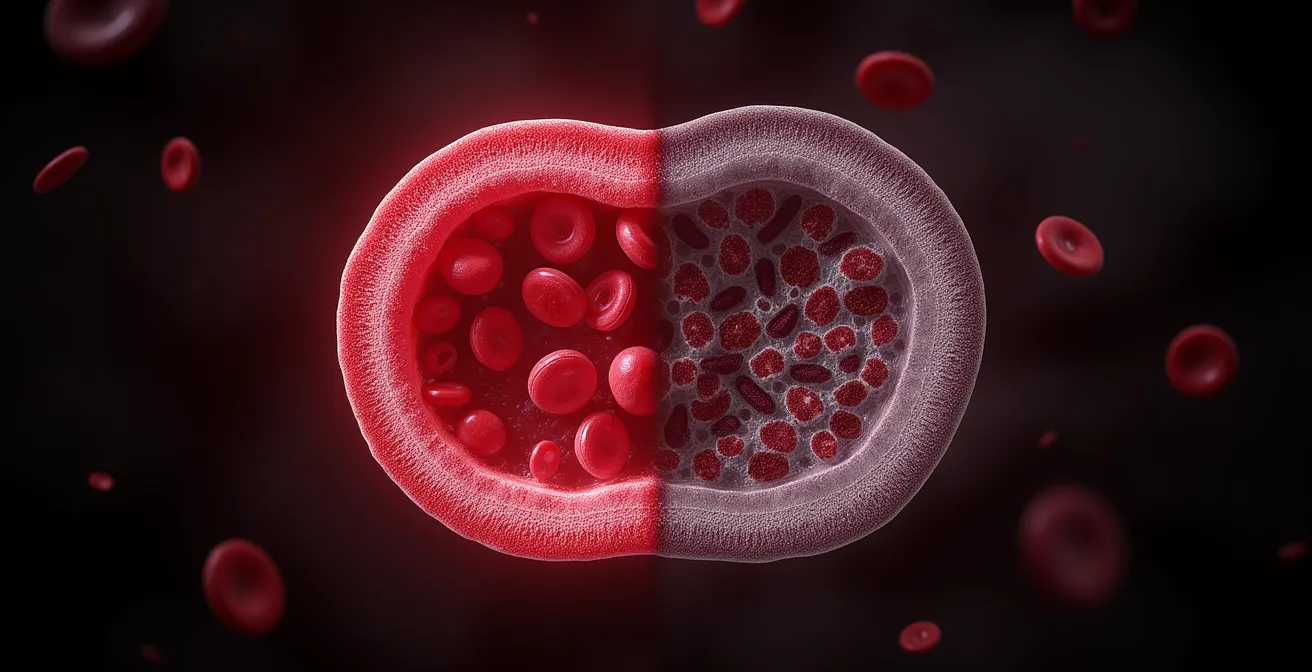
The persistent fatigue felt by smokers isn’t just about sleep; it’s a symptom of an ongoing oxygen debt caused by carbon monoxide (CO) hijacking your red blood cells. While CO levels drop significantly within 12 hours of your last cigarette, true recovery is a biochemical process. Understanding how oxygen reclaims your bloodstream explains why you feel tired, how your skin tone changes, and what a pulse oximeter won’t tell you, providing a clear map of your body’s return to health.
The feeling is deeply familiar to many smokers: a pervasive, bone-deep fatigue that a full night’s sleep can’t seem to touch. You wake up feeling unrefreshed, and simple tasks like climbing stairs leave you winded. This chronic exhaustion is often attributed to poor sleep quality or general unfitness, but its roots lie in a far more specific and insidious process happening at a microscopic level within your bloodstream: a constant state of oxygen deprivation engineered by carbon monoxide (CO).
Common wisdom states that the body “clears out” carbon monoxide within a day or so after quitting. While factually correct, this simple timeline fails to capture the profound biological struggle taking place. The core of the issue isn’t just the presence of CO, but its role in what can be described as hemoglobin hijacking. Every puff of a cigarette introduces this toxic gas, which has an affinity for the hemoglobin in your red blood cells that is over 200 times stronger than that of oxygen. It systematically displaces the oxygen your body needs for energy, creating a persistent, low-grade state of suffocation.
But what if the key to reclaiming your energy wasn’t just waiting for the clock to run out, but understanding this molecular battle? The real question is not just *when* the CO leaves, but how its departure allows for a cascade of positive changes. This process of cellular re-oxygenation directly impacts everything from your stamina and circulation to the very color of your skin. This article will deconstruct the timeline of your blood’s recovery, connecting the invisible world of blood chemistry to the physical sensations you experience as you heal.
To fully grasp this recovery process, we will explore the science behind smoker’s fatigue, what your vital signs really mean during this transition, the physical milestones to watch for, and how to safely return to exercise. This guide provides a detailed map of your body’s journey back to optimal oxygenation.
Summary: The Complete Timeline of Blood Oxygen Recovery After Smoking
- Why You Feel Tired All Day Despite Sleeping 8 Hours?
- Pulse Oximeter Readings: What Is Normal for a Smoker vs Non-Smoker?
- 3 Physical Signs Your Oxygen Levels Are Finally Normalizing
- The Danger of High-Intensity Cardio With Carbon Monoxide in Your Blood
- The 12-Hour Detox: What Happens to Your Blood Overnight?
- Why You Get Winded Climbing Stairs Even If You Don’t Smoke Much?
- The “Grey Cast”: How Oxygen Return Changes Your Skin Tone?
- Regaining Your VO2 Max: A Training Plan for Ex-Smokers
Why You Feel Tired All Day Despite Sleeping 8 Hours?
The chronic fatigue experienced by smokers, even after adequate rest, is a direct physiological consequence of carbon monoxide’s effect on the blood. The core issue is a persistent oxygen debt at the cellular level. When you smoke, CO molecules bind tightly to hemoglobin, forming carboxyhemoglobin (COHb). This “hijacked” hemoglobin is unable to transport oxygen to your muscles, brain, and organs. Consequently, your body is in a constant state of mild hypoxia, or oxygen deficiency, which manifests as profound tiredness and lack of stamina.
Even after a full night’s sleep, this effect lingers. Carbon monoxide has a biological half-life, meaning the time it takes for your body to eliminate half of the accumulated CO. In normal room air, this process is surprisingly slow. While it varies based on individual metabolism and lung function, rigorous research shows that carbon monoxide elimination half-life varies from 4.7 to 8.4 hours. This means that if you had your last cigarette at 10 PM, by 6 AM a significant amount of CO is still circulating in your blood, preventing full oxygen saturation.
This explains why you wake up feeling as though you haven’t truly rested. Your body has spent the night working with a compromised fuel line, unable to fully perform its restorative functions. The fatigue is not a sign of poor sleep hygiene; it is a clinical symptom of your body being starved of the fundamental molecule required for energy production: oxygen.
Pulse Oximeter Readings: What Is Normal for a Smoker vs Non-Smoker?
A pulse oximeter is a common medical device that clips onto a fingertip to measure blood oxygen saturation (SpO2). For a healthy non-smoker, a normal reading is typically between 95% and 100%. However, for a smoker, this device can be dangerously misleading. This is due to a critical limitation known as the “Oximeter Fallacy”: a standard pulse oximeter cannot differentiate between hemoglobin carrying oxygen (oxyhemoglobin) and hemoglobin carrying carbon monoxide (carboxyhemoglobin).
The device works by shining red and infrared light through the finger and measuring the absorption. Unfortunately, carboxyhemoglobin absorbs light at a similar wavelength to oxyhemoglobin. Therefore, a smoker might have a reading of 98%, but a substantial portion of that percentage could be useless, CO-bound hemoglobin. A specialized device called a CO-oximeter is required for an accurate measurement in a clinical setting. For smokers, typical carboxyhemoglobin baseline levels range from 10-15%, a level at which significant oxygen impairment is already occurring, despite what a standard oximeter might suggest.
This means a smoker with a 97% SpO2 reading may only have an actual oxygen-carrying capacity of 82-87%, placing a continuous strain on their cardiovascular system. The discrepancy between the apparent saturation and the actual functional oxygen level is a key reason why smokers feel breathless and fatigued despite seemingly “normal” readings.
As the comparison table below illustrates, the baseline level of carboxyhemoglobin (COHb) is dramatically different between smokers and non-smokers, highlighting the chronic oxygen deficit that smokers live with daily. This difference is the primary driver of the long-term health consequences associated with smoking.
| Population | Normal COHb Range | Clinical Significance |
|---|---|---|
| Non-smokers | 0.5-3% | Baseline endogenous production |
| Light smokers | 5-10% | Mild oxygen deficit |
| Heavy smokers (2 packs/day) | 10-15% | Significant oxygen impairment |
3 Physical Signs Your Oxygen Levels Are Finally Normalizing
As carbon monoxide is cleared from your system, your body’s ability to transport oxygen is restored. This cellular re-oxygenation isn’t just a number on a chart; it produces tangible, physical signs that you can feel and observe. These signals are your body’s way of confirming that it is healing. While the full recovery timeline unfolds over weeks and months, some of the most encouraging changes happen rapidly as your oxygen debt begins to resolve.
First, you will notice a return of warmth to your extremities. Carbon monoxide causes vasoconstriction (narrowing of blood vessels), particularly in the hands and feet. As CO levels drop and oxygen levels rise, your blood vessels begin to relax and dilate in a process of “vascular rebound.” This improves circulation, allowing warm, oxygen-rich blood to reach your fingers and toes more effectively. This change is often one of the earliest and most noticeable signs of cardiovascular improvement.
Second, a decrease in shortness of breath during mild exertion is a key indicator. With more hemoglobin available to carry oxygen, your body can meet the metabolic demands of activities like walking or climbing stairs more efficiently. Your heart doesn’t have to beat as fast and your breathing rate doesn’t need to increase as dramatically to compensate for the oxygen deficit. Finally, many people report improved mental clarity and reduced “brain fog.” Your brain is an oxygen-hungry organ, and even mild hypoxia can impair cognitive function, concentration, and memory. As it receives a steady, reliable supply of oxygen again, thinking becomes sharper and clearer.
Checklist for Monitoring Your Physical Recovery
- Within 20 minutes: Monitor your heart rate and blood pressure. You should notice them starting to drop back toward normal levels as the immediate stimulant effect of nicotine wears off and cardiovascular strain lessens.
- Within 12-24 hours: Pay attention to symptoms of fatigue and headache. As carbon monoxide levels normalize completely, the initial “detox” symptoms should begin to fade, indicating your blood’s oxygen-carrying capacity is restored.
- Within 2 weeks: Check the temperature of your hands and feet. Improved circulation should make them feel consistently warmer, a direct sign of vascular rebound.
- Within 1 month: Test your breathing during a brisk walk. Notice if your lung function feels improved, allowing you to go further with less breathlessness. Function can increase by up to 10% in this period.
- Within 9 months: Observe the frequency and severity of any chronic cough or shortness of breath. These symptoms should be significantly decreased as the cilia in your lungs regrow and clear out debris.
The Danger of High-Intensity Cardio With Carbon Monoxide in Your Blood
For a recent quitter eager to reclaim their fitness, jumping straight into high-intensity interval training (HIIT) or strenuous cardio can be not just counterproductive, but dangerous. The reason lies in the severe mismatch between oxygen supply and demand created by the lingering carbon monoxide. During intense exercise, your heart and muscles require a massive increase in oxygen. However, if a significant percentage of your hemoglobin is still hijacked by CO, your cardiovascular system is forced to work exponentially harder to deliver a compromised supply.
This puts the heart muscle itself under extreme stress. The heart requires a rich oxygen supply to function, and when that supply is limited, it can lead to a state of myocardial ischemia—a lack of oxygen to the heart muscle. This is the same underlying mechanism that causes a heart attack. Even at carboxyhemoglobin levels that might seem low, the risk is substantial. As noted in clinical analysis, myocardial impairment has been observed at COHb concentrations as low as 20%, and during high-intensity exercise, even lower levels can create dangerous ischemic conditions.
Engaging in strenuous activity during the initial 48-72 hours after quitting forces an already-strained heart to operate in a low-oxygen environment, increasing the risk of dangerous cardiac events. Studies on the acute effects of CO toxicity underscore this danger; a key analysis confirms that in cases of severe poisoning, CO-poisoned patients with severe metabolic acidosis have mortality rates of 30% to 50%, often due to cardiac arrhythmias. While this represents an extreme case, it illustrates the profound toxicity of CO to the heart and serves as a stark warning against overloading the system before it has fully recovered its oxygen-carrying capacity.
Clinical Finding: Carbon Monoxide and Cardiac Risk
Medical literature highlights a critical danger: “Cardiac ventricular arrhythmias may develop and often contribute to death in cases of carbon monoxide toxicity.” This illustrates that the primary danger is not just suffocation, but the direct toxic effect on the heart’s electrical stability. Critically, these effects are not limited to severe poisoning. The literature further states: “Myocardial impairment has been observed at COHb concentrations as low as 20%.” For a heavy smoker, whose baseline can be 10-15%, adding the immense oxygen demand of intense exercise can push them into this dangerous zone, creating a risk of arrhythmias or ischemia.
The 12-Hour Detox: What Happens to Your Blood Overnight?
The first night after your last cigarette is a period of profound and rapid healing for your bloodstream. While you sleep, your body begins the critical process of reclaiming its oxygen-carrying capacity. The most important milestone during this period is the dramatic reduction of carbon monoxide. According to the World Health Organization, a pivotal moment in recovery occurs very quickly: within 12 hours, carbon monoxide levels in the blood drop to normal, matching those of a non-smoker.
This process follows a predictable pattern of logarithmic decay, governed by the gas’s half-life. As stated by public health experts, the half-life of carbon monoxide in normal room air is approximately four to five hours. This means that every four to five hours, about half of the carboxyhemoglobin in your blood is broken down, freeing up the hemoglobin to bind with oxygen once again. After the first half-life, your CO level is down by 50%. After the second (8-10 hours), it’s down by 75%. By the 12-hour mark, after about 2.5 to 3 half-lives, the levels are negligible.

This overnight biochemical detox is the foundation for all subsequent health improvements. As oxygen begins to saturate your red blood cells fully, your organs and tissues finally receive the fuel they have been deprived of. This is why, even after a potentially restless first night without nicotine, many people report waking up on day one feeling a new sense of clarity or energy. Your body is no longer fighting an internal battle for oxygen, and the process of true cellular repair can finally begin.
Why You Get Winded Climbing Stairs Even If You Don’t Smoke Much?
The experience of getting breathless from a simple activity like climbing a flight of stairs is a classic sign of smoking’s impact, even for those who consider themselves “light” or “social” smokers. This isn’t a matter of poor cardiovascular fitness alone; it is a direct result of an acutely diminished oxygen supply. A single cigarette can have a measurable and immediate impact on your blood’s ability to transport oxygen, creating a temporary but significant oxygen debt.
Climbing stairs is a short, anaerobic burst of activity. It demands a sudden, large supply of oxygen to the leg muscles. In a non-smoker, the cardiovascular system responds by increasing heart rate to deliver more oxygen-rich blood. In a smoker, however, the system is already compromised. A person who smokes, even lightly, introduces a significant amount of carbon monoxide into their system. Data from health organizations shows that a person who smokes just one pack per day commonly has CO levels of around 20 ppm (parts per million) in their bloodstream, leading to carboxyhemoglobin levels of 5% or more.
When you begin climbing stairs, your muscles cry out for oxygen that simply isn’t there in sufficient quantity. Your body’s only way to compensate is to dramatically increase your heart rate and breathing rate—the sensation you perceive as getting “winded.” You are feeling the immediate consequence of hemoglobin hijacking. Even a small percentage of compromised hemoglobin is enough to create a functional deficit when the body is placed under sudden demand. It’s a clear, real-time demonstration of how even minimal smoking directly impacts your physical performance and capacity.
The “Grey Cast”: How Oxygen Return Changes Your Skin Tone?
One of the most visible signs of the damage caused by smoking is a change in skin tone. Many long-term smokers develop a dull, sallow, or “grey cast” to their complexion. This is not a superficial issue; it is a direct reflection of poor oxygenation and circulation at the skin’s surface. Carbon monoxide’s presence in the blood plays a dual role in this process: it reduces the oxygen content of the blood and also contributes to the constriction of tiny blood vessels (capillaries) in the skin.
The color of our skin is influenced by the blood flowing through these capillaries. Healthy, oxygen-rich blood is bright red, which imparts a rosy, vital glow to the complexion. However, deoxygenated blood is a darker, bluish-red. Furthermore, as the American Thoracic Society points out, the color of carboxyhemoglobin itself is a brighter cherry red than oxyhemoglobin, which can paradoxically mask the underlying hypoxia in some cases of acute poisoning, but in chronic smokers, the combination of poor perfusion and reduced oxygen leads to a lackluster appearance.
Upon quitting, the change can be remarkably swift. As CO is eliminated, two things happen. First, the blood becomes fully saturated with oxygen, returning it to a healthy, vibrant red. Second, the vascular rebound effect kicks in: the capillaries in the skin dilate, improving blood flow. This increased perfusion of oxygen-rich blood to the skin’s surface is what restores a healthy, rosy complexion. This visual improvement is a powerful external confirmation of the profound internal healing that is taking place, as improved circulation benefits every organ in the body.
Because carboxyhemoglobin is a brighter shade of red than oxyhemoglobin and the color of capillary blood contributes to skin color, it would seem reasonable that a poisoned patient’s appearance might change.
– American Thoracic Society, Practice Recommendations in Carbon Monoxide Poisoning
Key Takeaways
- Carbon monoxide’s half-life of 4-8 hours means fatigue persists even after a night’s sleep due to a lingering “oxygen debt.”
- Standard pulse oximeters are misleading for smokers, as they can’t distinguish between oxygen-carrying and CO-hijacked hemoglobin, hiding the true extent of oxygen deficiency.
- Physical recovery signs like warmer hands, better skin tone, and reduced breathlessness are direct results of improved circulation (vascular rebound) and cellular re-oxygenation.
Regaining Your VO2 Max: A Training Plan for Ex-Smokers
Once carbon monoxide has been eliminated from your system, the journey toward reclaiming your full physical potential begins. The ultimate metric for cardiovascular fitness and endurance is VO2 max: the maximum rate at which your body can utilize oxygen during intense exercise. Smoking devastates VO2 max by attacking the system at every level—reducing the blood’s oxygen-carrying capacity, damaging lung tissue, and straining the heart. Rebuilding it requires a safe, structured, and progressive approach.
With CO no longer hijacking your hemoglobin, your blood is now capable of transporting a full supply of oxygen. The goal of training is to improve your body’s ability to use that oxygen effectively. Research indicates that even after years of smoking, significant recovery is possible; for instance, some studies show lung function increases by approximately 10% within the first few months of quitting. A gradual training plan allows your heart, lungs, and muscles to adapt and strengthen without the risks associated with premature high-intensity exercise.
The following protocol, based on clinical guidance, provides a safe pathway to rebuilding your aerobic base and, eventually, your VO2 max:
- Weeks 1-2: Foundation Phase. Focus exclusively on low-intensity activity like walking. The priority here is consistency and re-establishing a routine. Incorporate deep breathing exercises to improve diaphragm strength and lung capacity.
- Weeks 3-4: Aerobic Base Building. Introduce light aerobic activity (e.g., stationary bike, brisk walking, light jogging) for 20-30 minutes, 3 times a week. Maintain an intensity of 40-50% of your maximum heart rate. The goal is to sustain effort, not to push your limits.
- Weeks 5-8: Progressive Overload. Gradually increase the duration or frequency of your workouts. You can now increase the intensity to a moderate level, around 60-70% of your max heart rate. You should be able to hold a conversation during this activity.
- Month 3+: Introducing Intensity. If you feel strong and have been consistent, you can begin incorporating interval training. Start with short bursts of higher effort (e.g., 30 seconds) followed by longer recovery periods (90 seconds). This is key to pushing your VO2 max ceiling.
- Month 4 and Beyond: Full Capacity. You can now return to a more normalized training regimen, but always listen to your body. Monitor for any unusual symptoms like dizziness or chest discomfort, and prioritize proper warm-ups, cool-downs, and recovery.
By understanding the science of recovery and committing to a safe, progressive plan, you can effectively reverse the damage of carbon monoxide and reclaim the energy and vitality that smoking has stolen.