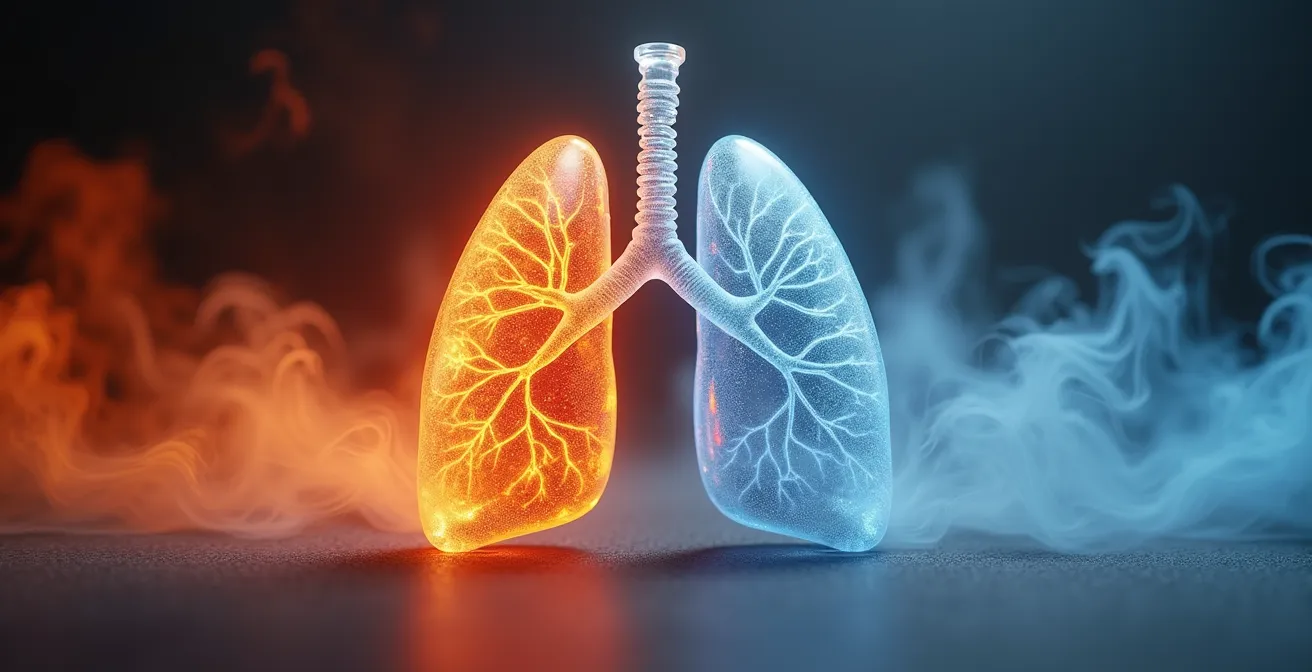
The fundamental difference between smoking and vaping lies in temperature: smoking involves uncontrolled combustion above 600°C, while vaping uses controlled heating below 250°C to create an aerosol.
- Combustion (smoking) is a process of burning that creates thousands of new, toxic chemicals, including at least 70 known carcinogens.
- Vaporization (vaping) heats a liquid until it becomes an aerosol, largely avoiding the formation of these combustion-related toxicants.
Recommendation: Understanding that the danger comes from the high-temperature chemical reaction of burning, not just the substance itself, is the first step toward making an informed harm-reduction choice.
For any smoker contemplating a switch to vaping, the core question isn’t about trading one habit for another; it’s a question of chemistry and safety. You’ve likely heard the simple harm-reduction arguments, but they often lack the scientific foundation needed for a truly informed decision. The debate isn’t merely about tobacco versus e-liquid. It is a fundamental conflict between two distinct chemical processes: high-temperature combustion and low-temperature vaporization. The health implications are not just different; they are orders of magnitude apart, and the deciding factor is the thermal threshold at which these reactions occur.
Most discussions focus on the presence of nicotine, but this misses the main point. The primary danger of traditional cigarettes is born in the fire at their tip. This process of burning, known as pyrolysis, is an uncontrolled chemical reaction that breaks down organic matter to create a complex and deadly cocktail of new substances. In contrast, electronic cigarettes are designed to specifically avoid this thermal threshold. They operate on a principle of controlled heating to turn a liquid into an aerosol, a process that is chemically far simpler and cleaner.
This article will dissect the chemical science behind both methods. We will not rely on platitudes but on objective, data-driven analysis. By exploring the specific temperatures, the resulting byproducts, and the mechanisms of different devices, you will gain a clear understanding of why moving from combustion to vaporization is a radical shift in chemical exposure for your lungs. This is not about advocating for vaping, but about providing the chemical facts necessary to comprehend the profound difference between smoke and aerosol.
This guide breaks down the essential science, from the critical temperature points that define risk to the practical steps for those considering the switch. Explore the sections below to understand the chemistry that dictates lung health.
Summary: Combustion vs. Vaporization: A Chemical Analysis
- Why Heating Above 400°C Changes Everything for Your Lungs?
- The 7000 Chemicals: What Exactly Is Eliminated by Switching?
- How Heat-Not-Burn Devices Differ From Traditional Vapes?
- The Danger of Dry Hits: When Vaping Becomes Combustible
- Keeping Vape Temps Low to Minimize Harmful Byproducts
- Why Heating Tobacco Above 800°C Creates New Carcinogens?
- If It’s Not Tar, What Is That Brown Residue in My Device?
- Switching to E-Cigarettes: A Starter Guide for 20-Year Smokers
Why Heating Above 400°C Changes Everything for Your Lungs?
The distinction between a relatively safe process and a highly hazardous one is often a matter of degrees—literally. In the context of tobacco and nicotine consumption, the 400°C mark represents a critical thermal threshold. Below this point, substances can be heated to create an aerosol. Above it, you enter the realm of combustion, a chemical process of burning that fundamentally alters organic matter, creating a vast array of new and harmful compounds. A conventional cigarette doesn’t just smolder; it operates as a miniature, uncontrolled chemical reactor.
When a cigarette is lit, the temperature at the burning cone rapidly exceeds 600°C and, during a puff, can spike dramatically. Scientific studies confirm that cigarette tips can reach temperatures of around 900°C. At these extreme temperatures, the tobacco, paper, and additives undergo pyrolysis—thermal decomposition. This is not a clean or simple process. It violently shatters complex organic molecules and forces them to recombine into thousands of new substances, many of which are toxic and carcinogenic. This is the origin of tar and the complex mixture known as cigarette smoke.
The reason 400°C is so significant is that it’s the general temperature region where these destructive pyrolytic reactions begin to accelerate. By staying below this threshold, as heat-not-burn devices and vaporizers are designed to do, the chemical integrity of the original substances is largely preserved. For example, some heat-not-burn systems are engineered to heat tobacco to no more than 350°C. This is hot enough to release nicotine and flavor in an aerosol, but cool enough to prevent the tobacco from actually burning. By avoiding combustion, you fundamentally change the chemical output, and therefore, the exposure to your lungs.
The 7000 Chemicals: What Exactly Is Eliminated by Switching?
The smoke from a single burning cigarette is not a simple substance; it is a complex aerosol containing solid particles, liquids, and gases. As a direct result of the high-temperature combustion described previously, this smoke is a toxic soup. The World Health Organization has identified that cigarette smoke contains over 7000 chemicals, with at least 250 known to be toxic and around 70 identified as carcinogens. These are not chemicals that were present in the original tobacco leaf; they are byproducts created by the fire.
When you switch from combustion to vaporization, you are not just changing the delivery system; you are sidestepping the chemical factory that produces these toxicants. Compounds like arsenic, benzene, formaldehyde, and carbon monoxide are either entirely absent or present at drastically lower levels in the aerosol from an e-cigarette. The famous “95% safer” figure, often cited by public health bodies in the UK, stems from studies comparing the chemical profiles of cigarette smoke to e-cigarette vapor. While the exact number is debated, the underlying principle is chemically sound. For instance, scientific evidence from some studies has shown that the aerosol from certain smoke-free alternatives contains an average of 95% lower levels of toxicants compared to cigarette smoke.
What is eliminated is the vast majority of combustion-related byproducts. The aerosol from a typical e-cigarette primarily consists of propylene glycol (PG), vegetable glycerin (VG), nicotine, and food-grade flavorings. While not entirely without risk, and long-term effects are still being studied, this chemical profile is vastly simpler and less hazardous than the complex list of carcinogens found in smoke. It’s also important to address common fears; the chemical responsible for “popcorn lung,” diacetyl, is banned in e-liquids in many regions like the EU and UK, but remains present at high levels in cigarette smoke.
How Heat-Not-Burn Devices Differ From Traditional Vapes?
While both heat-not-burn (HnB) devices and traditional e-cigarettes (vapes) operate on the principle of avoiding combustion, they are chemically distinct systems. The primary difference lies in the substance being heated: HnB devices use actual tobacco, whereas vapes use a liquid solution known as e-liquid. This distinction leads to different operating temperatures and chemical outputs, placing them at different points on the harm-reduction spectrum.
This image illustrates the temperature gradient across different nicotine delivery systems, highlighting the core difference in their operational heat.

As the visual suggests, HnB devices occupy a middle ground. They heat specially designed tobacco sticks to a temperature of around 350°C. This is hot enough to create a nicotine-containing aerosol from the tobacco but remains below the 400°C+ threshold for combustion. The resulting aerosol contains nicotine and tobacco flavor, which many smokers find more satisfyingly similar to a cigarette, but with significantly lower levels of harmful chemicals than smoke. Traditional e-cigarettes, or vapes, operate at an even lower temperature range, typically between 100°C and 250°C. They heat an e-liquid—a solution of nicotine, flavorings, propylene glycol, and vegetable glycerin—to produce an aerosol. Because there is no tobacco, there is no risk of it burning, and the chemical profile of the aerosol is even simpler than that of HnB devices.
From a chemical standpoint, the choice between them involves a trade-off. HnB provides an experience closer to smoking by using real tobacco but operates at a higher temperature and produces a more complex aerosol than a vape. Vapes offer a cleaner chemical process at a lower temperature but with an experience further removed from traditional smoking. Both, however, represent a significant reduction in exposure to toxicants compared to combustible cigarettes.
The Danger of Dry Hits: When Vaping Becomes Combustible
While vaporization is chemically far safer than combustion, it is not an infallible system. The primary risk of creating harmful byproducts in a vape occurs during an event known as a “dry hit” or “dry puff.” This happens when the heating element (the coil) is activated without enough e-liquid to vaporize. Instead of heating the liquid, the coil’s temperature can spike dramatically, charring the wicking material (usually cotton) and any residual e-liquid. This is a form of thermal runaway where the system operates outside its intended parameters.
The experience of a dry hit is intensely unpleasant, characterized by a harsh, acrid, and burnt taste that is immediately repulsive to the user. This aversive nature is a built-in safety feature, as it signals that something is chemically wrong. As leading e-cigarette researcher Dr. Konstantinos Farsalinos explains, this is a critical distinction from the risks of smoking:
A dry puff happens when an atomizer heats up and has no liquid to vaporize. This results in the wick drying out and charring any available liquid, leading to a terrible taste.
– Dr. Konstantinos Farsalinos, Study on aldehyde emissions replications
The chemical danger of a dry hit is that the extreme temperature can cause the components of the e-liquid, like propylene glycol and vegetable glycerin, to break down into harmful aldehydes, such as formaldehyde and acrolein. Studies that have reported alarmingly high levels of formaldehyde in e-cigarette aerosol were often conducted under these unrealistic “dry puff” conditions, which vapers actively avoid due to the terrible taste. Under normal operating conditions, with a properly saturated wick, the levels of these aldehydes are significantly lower than those found in cigarette smoke. Therefore, preventing dry hits by keeping the tank full and the wick saturated is the single most important practice for ensuring the chemical safety of vaping.
Keeping Vape Temps Low to Minimize Harmful Byproducts
The key to harm reduction through vaping is maintaining control over the chemical reactions, and the primary variable for that control is temperature. As established, the goal is to keep the heating process squarely within the vaporization window and far away from the thermal thresholds of combustion or decomposition. Modern vaping devices offer several ways to achieve this, but the user’s understanding and maintenance are paramount. The e-liquid in a standard vape is designed to turn into an aerosol at a relatively low temperature.
Most basic e-cigarettes are pre-set to operate within a safe range, where the e-liquid reaches a temperature of roughly 100-250°C. This is well below the point where the primary ingredients (PG and VG) begin to break down into significant levels of harmful aldehydes. However, more advanced devices offer features like “temperature control” (TC). A TC-enabled device allows the user to set a maximum temperature for the coil. The device then constantly monitors the coil’s resistance to ensure it never exceeds that limit, effectively eliminating the possibility of a dry hit and ensuring a consistent, clean vaporization process.
For users of any device, the principles of maintaining low temperatures are universal. Proper maintenance, such as regularly changing coils and ensuring the wick is always saturated with e-liquid, prevents the temperature spikes that lead to unwanted byproducts. The choice of e-liquid can also play a role, as certain flavorings or high sweetener content can degrade and build up on the coil, leading to “hot spots” and inconsistent heating. The following checklist provides a practical guide to maintaining optimal and safe operating temperatures.
Action plan: Maintaining optimal vaping temperature
- Monitor Temperature Settings: If your device has temperature control (TC), set it within the recommended range for your coil type, typically between 200-250°C (392-480°F). Avoid pushing the limits.
- Ensure E-Liquid Saturation: Always keep your tank or pod sufficiently filled. Before first use of a new coil, prime it by adding a few drops of e-liquid directly onto the wick and letting it sit for several minutes.
- Recognize Precursors to Dry Hits: Pay attention to a muted or slightly burnt taste. This is a sign your wick is not saturated enough and a dry hit is imminent. Stop, check your liquid level, and re-saturate.
- Choose Coils and Wattage Wisely: Use coils within their recommended wattage range. Running a coil at a wattage that is too high will overheat it, causing decomposition of the e-liquid regardless of saturation.
- Regularly Clean and Maintain Your Device: Clean the tank and connections periodically. Replace coils as soon as you notice a persistent burnt taste or a significant drop in performance, as old residue can cause uneven heating.
Why Heating Tobacco Above 800°C Creates New Carcinogens?
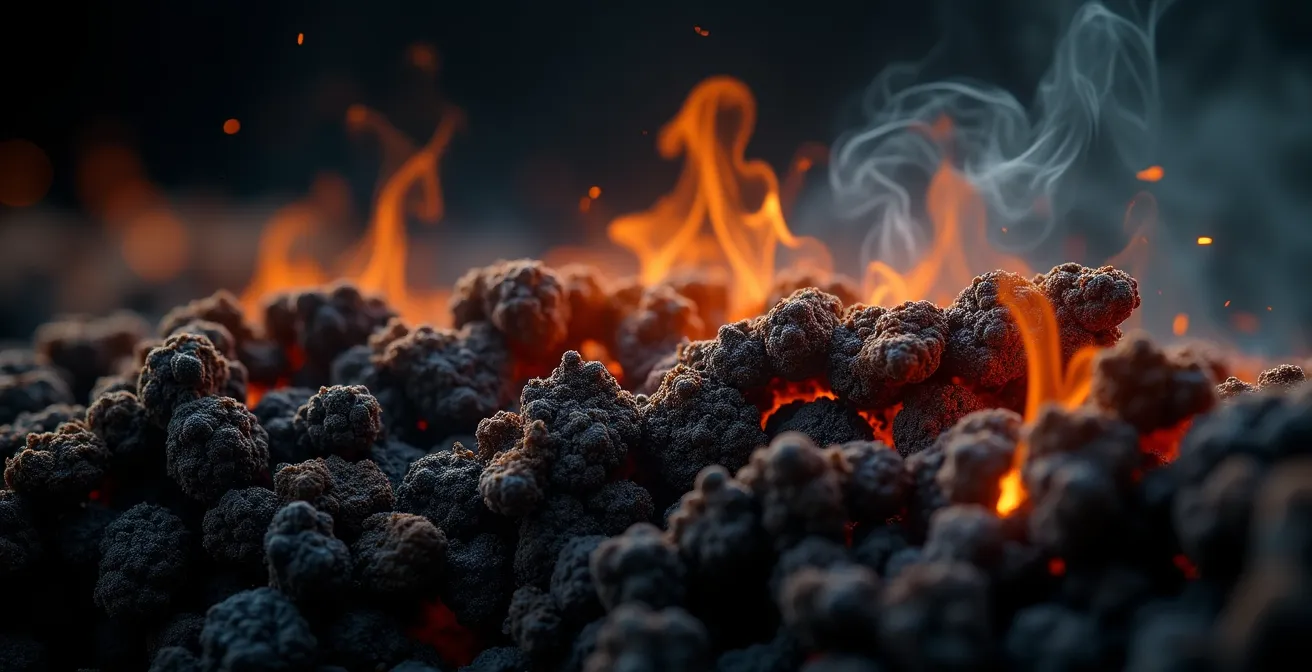
If 400°C is the threshold where combustion begins, the 800°C mark represents the inferno where the most dangerous chemical transformations occur. When a smoker takes a puff, the rush of oxygen over the lit tip causes a temperature surge. Multiple studies indicate temperatures usually in the range of 800-900°C during this brief moment. At this extreme heat, the chemical process of pyrolysis goes into overdrive, becoming a far more destructive and generative reaction.
This image provides a macro view of tobacco undergoing this intense thermal decomposition, where organic matter is broken down and reformed into a complex mix of solid particles and gases that constitute smoke.
At temperatures above 800°C, the molecular bonds within the tobacco plant matter are not just broken; they are obliterated. This creates a chaotic environment of highly reactive free radicals—unstable molecular fragments. These fragments desperately seek stability by recombining with each other in countless random configurations. This process, known as pyrosynthesis, is responsible for the creation of some of the most potent carcinogens known to science, including polycyclic aromatic hydrocarbons (PAHs) like benzo[a]pyrene, and tobacco-specific nitrosamines (TSNAs). These compounds are not naturally present in the tobacco leaf in significant quantities; they are born in the fire.
This is the fundamental reason why smoking is so uniquely dangerous. It’s not just that you are inhaling tobacco; you are inhaling the thousands of new chemicals created by setting it on fire at incredibly high temperatures. The energy supplied by this extreme heat is sufficient to force the creation of complex and stable carcinogenic molecules that would otherwise never form. By keeping temperatures well below this pyrosynthesis zone, alternative products like vapes and HnB devices prevent the formation of this specific and most dangerous class of carcinogens.
If It’s Not Tar, What Is That Brown Residue in My Device?
A common point of confusion for those new to vaping is the eventual appearance of a dark, sticky residue inside their device or on the coil. Given its appearance, many understandably mistake it for tar, the toxic byproduct of tobacco combustion. However, from a chemical standpoint, this residue is fundamentally different and arises from much gentler processes. It is not tar, because tar is, by definition, a product of combustion, which does not occur in a properly functioning vape.
The brown residue is primarily the result of two well-understood chemical reactions that occur at the relatively low temperatures of vaping: caramelization and the Maillard reaction. These are the same processes that brown your toast or give a steak its savory flavor. Caramelization is the thermal decomposition of sugars. Many e-liquids, especially dessert and fruit flavors, contain sweeteners. When heated repeatedly by the coil, these sweeteners slowly break down and polymerize, forming the dark, sticky compounds that build up over time.
The Maillard reaction is a more complex interaction between amino acids and reducing sugars. While less of a contributor than caramelization, it can also play a role in creating the flavor notes and coloration. A chemical analysis of e-cigarette residue confirms this benign origin:
The residue in vaping devices is primarily the result of Maillard reactions and caramelization of sweeteners and vegetable glycerin, not tar from combustion
– Vaping chemistry analysis, Analysis of e-cigarette residue composition
While this residue can eventually impact the flavor and performance of a device by gunking up the coil, it is chemically distinct from the toxic, carcinogenic sludge that is cigarette tar. Understanding this difference is key to demystifying the vaping process and recognizing that visual similarities do not imply chemical equivalence.
Key Takeaways
- The primary danger of smoking comes from high-temperature combustion (>600°C), which creates over 7,000 chemicals, including many carcinogens.
- Vaping operates at a much lower temperature (100-250°C), largely avoiding combustion and its toxic byproducts by creating an aerosol instead of smoke.
- The brown residue in a vape is from caramelization of sweeteners, not tar. Dry hits, caused by a lack of e-liquid, are the main risk in vaping as they can create harmful aldehydes, but are easily avoided.
Switching to E-Cigarettes: A Starter Guide for 20-Year Smokers
For a long-term smoker, the decision to switch is about more than just understanding the chemistry; it’s about finding a viable and satisfying alternative that can effectively replace the habit. The success of a switch often hinges on managing nicotine cravings. A common fear is that e-cigarettes won’t deliver nicotine as effectively as a traditional cigarette, leading to a frustrating experience and an eventual return to smoking. It’s a valid concern, as the pharmacokinetics—the speed and level of nicotine absorption—are different.
Cigarettes are notoriously efficient at delivering a rapid nicotine spike to the brain. While early e-cigarettes were less effective, modern devices have improved significantly. Heat-not-burn devices, because they use real tobacco, can offer a nicotine delivery profile that is remarkably close to that of a cigarette. For example, one analysis found that the IQOS smoke had 84% of the nicotine found in conventional cigarettes, providing a very similar level of satisfaction for the user. Vapes using nicotine salts, a different formulation of nicotine, are also designed to provide a faster, smoother nicotine hit that more closely mimics a cigarette’s effect compared to earlier “freebase” nicotine e-liquids.
For a 20-year smoker, starting with a device that provides a satisfying nicotine experience is crucial. This might mean beginning with a higher nicotine concentration (e.g., 18-20 mg/mL in e-liquids or using a pod system with nicotine salts) or trying a heat-not-burn device. The goal is to make the switch as seamless as possible by satisfying the initial craving, after which the nicotine level can be gradually reduced over time if desired. The key is to find a system that works for you personally, allowing you to completely leave the world of high-temperature combustion behind for good.
By understanding the core chemical differences dictated by temperature, you are now equipped to make an informed decision based on science, not just headlines. The journey away from combustion is a significant step for your long-term health, and choosing the right tool is the next logical step in that process.