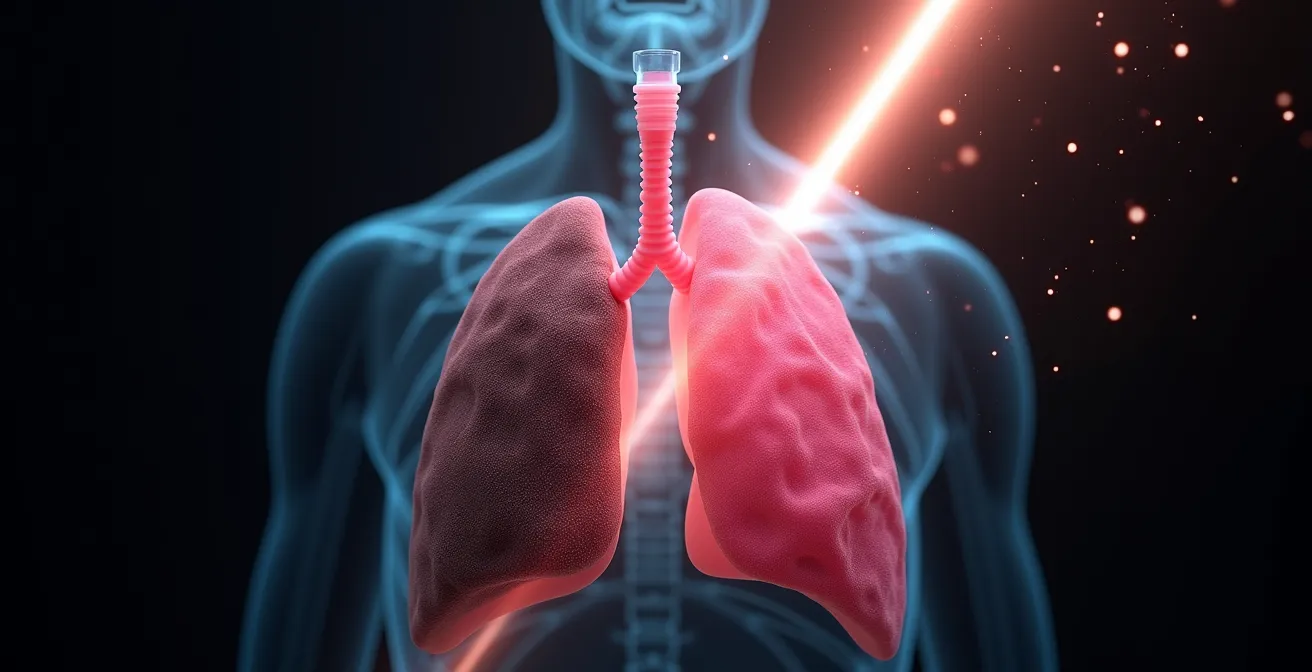
Quitting smoking isn’t about ‘scrubbing’ your lungs; it’s about activating your body’s powerful, built-in repair systems.
- The “smoker’s cough” is a productive sign of healing as your cilia (the lungs’ cleaning crew) regrow and clear debris.
- Specific nutrients and therapies can support, but not replace, the natural process of expelling tar and replacing damaged cells.
Recommendation: Focus on long-term consistency and supporting these biological functions, not on quick-fix ‘detoxes’.
The image of “black lungs” stained with tar is a powerful and persistent fear for anyone who has smoked for a significant period. After 20 years, it’s easy to believe the damage is permanent, a debt that can never be repaid. This leads to a desperate search for ways to “clean” or “detoxify” the lungs, as if they were a stained carpet that could be scrubbed back to new. Many will suggest antioxidant teas, aggressive exercise regimens, or expensive supplements, all promising to flush out the toxins.
From a physiological standpoint, however, this approach is fundamentally misguided. Your lungs are not a passive filter but a dynamic, self-repairing organ. The real question is not “Can I clean my lungs?” but rather, “How can I best support my lungs’ incredible, natural ability to clean themselves?” The body has a sophisticated mechanism for this, known as the mucociliary escalator, which works tirelessly to remove foreign particles. Smoking paralyzes this system, but quitting allows it to restart.
This article will shift your perspective from forceful “cleansing” to informed support. We will explore the science behind what happens when your lungs’ cleaning crew—the bronchial cilia—wakes up. We will examine the real meaning behind symptoms like coughing up phlegm, investigate which natural compounds and therapies genuinely assist the process, and demystify the long-term timeline for cellular repair. Understanding these biological mechanisms is the first step toward true, lasting lung recovery, no matter how long you’ve smoked.
To navigate this journey of healing, this article breaks down the key stages and scientific principles of lung recovery. The following sections will guide you through the body’s response to quitting, from immediate changes to long-term cellular regeneration.
Summary: A Scientific Look at Lung Recovery After Smoking
- Does Coughing Up Phlegm Mean Your Lungs Are Healing?
- 5 Ingredients That Assist Your Lungs’ Natural Cleaning Process
- Steam Therapy vs Mucus Medication: What Works Best?
- Why Taking Cough Medicine Might Delay Your Lung Recovery?
- The 10-Year Path: Visualizing How Tar Fades Over Time
- Why Heating Tobacco Above 800°C Creates New Carcinogens?
- The 7000 Chemicals: What Exactly Is Eliminated by Switching?
- The Regrowth of Bronchial Cilia: Why You Get Sick After Quitting?
Does Coughing Up Phlegm Mean Your Lungs Are Healing?
For many who have just quit smoking, an increase in coughing and phlegm production can be alarming. It feels counterintuitive—shouldn’t you be getting better, not worse? However, this is one of the most important and positive signs that your lungs are beginning the healing process. This phenomenon is known as a productive cough, and it signifies that the cleaning systems in your airways are waking up and getting back to work. For years, these systems were paralyzed by the chemicals in cigarette smoke.
The color and consistency of the phlegm provide direct clues about the stage of recovery. As your lungs begin to clear out the accumulated debris, the phlegm may appear dark, sometimes with brown or black specks. This is the tar and particulate matter that has been trapped in your airways being expelled. Over weeks and months, as the cleaning progresses, the phlegm will gradually lighten in color, transitioning to yellowish and finally to clear or white. This visual progression is a tangible sign of your progress.
Case Study: Phlegm Color Progression During Lung Recovery
Observational data from individuals quitting smoking shows a consistent pattern. Phlegm typically starts darker with brown or black specks and gradually becomes white or yellowish as lungs clear. The presence of white phlegm is often an indicator that the lungs are nearly finished with the most intensive phase of cleaning themselves of particulate matter.
Therefore, instead of viewing this cough as a setback, it should be reframed as a crucial and encouraging part of your recovery. It is physical proof that your body’s natural defenses are powerfully reasserting themselves. Suppressing this cough can actually hinder the very process it signifies.
5 Ingredients That Assist Your Lungs’ Natural Cleaning Process
While the body’s ability to heal is profound, certain compounds can provide valuable support to the natural cleaning and repair mechanisms of the lungs. This isn’t about a magical “detox,” but about providing the right biochemical tools to reduce inflammation, thin mucus, and protect newly healing tissues. Incorporating these elements can help make the recovery process more efficient and less symptomatic. For instance, some research highlighted by Healthline suggests that green tea’s anti-inflammatory properties may offer a degree of protection against certain lung diseases.
The goal is to target key biological processes. One is thinning mucus to make it easier for the cilia to expel. Another is fighting inflammation, which is a chronic state in a smoker’s lungs. A third, more advanced concept is helping the body clear out senescent cells—damaged “zombie” cells that linger and promote inflammation. Below are five ingredients backed by research for their supportive roles.
- N-acetylcysteine (NAC): This powerful compound acts as a mucolytic, meaning it thins mucus by breaking down its chemical bonds. It also replenishes glutathione, a master antioxidant that is heavily depleted by smoking.
- Quercetin: Found in onions and apples, quercetin is a natural senolytic. It helps the body identify and clear out senescent (damaged) cells in lung tissue, reducing long-term inflammation.
- Fisetin: Another potent senolytic found in strawberries, fisetin has shown significant potential in research for its ability to remove these “zombie” cells and promote a healthier cellular environment.
- Omega-3 Fatty Acids: Found in fatty fish, flaxseeds, and walnuts, these are essential for combating the chronic, low-grade inflammation that smoking leaves behind, allowing tissues to heal more effectively.
- Green Tea Compounds (EGCG): The catechins in green tea are powerful antioxidants and anti-inflammatories that help protect lung tissue from oxidative stress during the recovery period.
Integrating these compounds through diet or supplementation, under medical guidance, can provide a significant boost to your body’s self-healing efforts. They work in synergy with your natural recovery, providing the building blocks for repair.
Steam Therapy vs Mucus Medication: What Works Best?
As your lungs work to expel mucus, you may experience periods of significant congestion. Two common approaches to manage this are steam therapy and over-the-counter mucus medications. While both aim to make coughing more productive, they work through different mechanisms and are best suited for different situations. Understanding their roles can help you choose the most effective strategy for relief.
Steam therapy is a simple, non-pharmacological method. Inhaling warm, moist air helps to hydrate the mucus blanket lining your airways. This doesn’t chemically alter the mucus but makes it less viscous and easier for the newly functioning cilia to move. It provides immediate, albeit temporary, relief and is excellent for daily maintenance and soothing irritated airways.

On the other hand, medications known as expectorants, like guaifenesin, work systemically. They are thought to increase the water content of mucus, effectively thinning it from the inside out. This is particularly useful for periods of thick, stubborn congestion. Beyond these two, physiotherapy techniques, adapted from treatments for conditions like cystic fibrosis, can offer superior mucus clearance through controlled coughing and postural drainage. To make an informed choice, a direct comparison is useful.
The following table, based on an analysis of different treatment methods, breaks down the options to help you decide what’s best for your symptoms.
| Treatment Method | Mechanism | Best Used For | Effectiveness Timeline |
|---|---|---|---|
| Steam Therapy | Hydrates mucus blanket, maintains optimal viscosity | Daily maintenance, symptom relief | Immediate temporary relief |
| Expectorants (Guaifenesin) | Thins mucus for easier expulsion | Thick, stubborn congestion periods | Relief within 30-60 minutes |
| Physiotherapy Techniques | Postural drainage, controlled ‘huff’ coughing | Superior mucus removal, adapted from cystic fibrosis treatment | Immediate with practice |
| Hydration (64oz water daily) | Maintains mucus viscosity for cilia function | Essential foundation for all methods | Ongoing support |
Why Taking Cough Medicine Might Delay Your Lung Recovery?
When faced with a persistent cough after quitting smoking, the immediate instinct is often to reach for a cough suppressant. It seems logical: the cough is annoying, so stopping it should bring relief. However, from a pulmonologist’s perspective, suppressing a productive “smoker’s cough” is one of the worst things you can do for your recovery. This cough is not a disease; it is the sound of healing.
Coughing after quitting smoking helps to remove the irritants from your lungs, so it’s not a good idea to try to suppress it with cough medicines.
– CBQ Method specialists, CBQ Method smoking cessation program
The reason lies in the function of your bronchial cilia. As we’ve discussed, these microscopic hairs are the engine of your lungs’ self-cleaning system. Smoking paralyzes them. When you quit, they begin to regrow and “wake up.” Their job is to beat in a coordinated wave to move the blanket of mucus—and all the trapped tar and debris—up and out of your lungs. This upward movement of debris is what triggers the cough reflex. In essence, the cough is the final, essential step in expelling decades of accumulated toxins. Taking a cough suppressant is like telling the cleaning crew to stop working just as they’ve started clearing out the trash.
This healing phase is temporary. Reports from Southern New Hampshire Health state that cilia regain nearly full function within 1-3 months, at which point the need to cough so frequently will naturally subside. By allowing your body to go through this process, you are accelerating the removal of harmful substances and paving the way for healthier lung tissue. Instead of suppressing the cough, focus on supporting it by staying hydrated and using expectorants or steam to make it as productive as possible.
The 10-Year Path: Visualizing How Tar Fades Over Time
The fear of permanent damage after 20 years of smoking is understandable, but the body’s capacity for repair is remarkable, extending over many years. While some damage, like emphysema, is irreversible, much of the functional and cancer-risk-related damage is not. Visualizing the long-term recovery path can provide powerful motivation. The most significant metric is cancer risk. A 2024 Healthline medical review confirms that after 10 years of being smoke-free, your risk of developing lung cancer is cut in half compared to someone who continues to smoke. This is a direct result of the body clearing damaged cells and replacing them with healthy ones.
This isn’t just a statistical probability; it’s a visible process at the cellular level. Tar staining itself fades as macrophages (the lungs’ cleanup cells) ingest and remove particulate matter, and as new, healthy pink tissue replaces old, damaged tissue. This process of cellular replacement is key.
Study: DNA Damage Avoidance in Lung Cells
Groundbreaking research from 2020 revealed a fascinating protective mechanism. It found that even in long-term smokers, a population of lung cells manages to avoid the extensive DNA damage caused by tobacco. After quitting, these resilient cells are able to multiply and help replenish the airways with healthy, undamaged tissue, a process that occurs regardless of how long the person had smoked.
This long-term healing is not just an invisible process; it can be measured. Tracking functional improvements provides tangible evidence of your progress and reinforces the benefits of staying smoke-free. Below is a checklist of key metrics that a healthcare provider can help you monitor.
Your Action Plan: Key Metrics for Tracking Lung Recovery
- Schedule a Spirometry (FEV1) Test: Work with your doctor to measure your Forced Expiratory Volume. You can see up to a 30% improvement in lung function in the first three months.
- Ask About a FeNO Test: A Fractional exhaled Nitric Oxide (FeNO) test quantifies the reduction of inflammation in your airways, a direct measure of healing.
- Monitor Peak Flow: Use a simple peak flow meter at home to track daily improvements in your breathing capacity and see your progress in real-time.
- Track Exercise Tolerance: Note how far you can walk or climb stairs without breathlessness. This is a powerful real-world indicator of increased stamina.
- Confirm Carbon Monoxide Levels: Ask for a CO test. Levels return to that of a non-smoker within just 12-24 hours, an immediate and motivating victory.
Why Heating Tobacco Above 800°C Creates New Carcinogens?
To understand lung damage, we must look at the source: combustion. The danger in a cigarette is not just the tobacco leaf itself, but the extreme chemical reaction that occurs when it burns. A lit cigarette reaches temperatures exceeding 800-900°C (over 1600°F) at the tip. At this intense heat, the organic material undergoes pyrolysis and combustion, a process that breaks down chemical compounds and creates thousands of new, highly toxic ones.
This is a critical distinction. A raw tobacco leaf contains harmful substances like nicotine, but the act of burning it creates a chemical factory. As Dr. Azeem Elahi from CaroMont Pulmonary Medicine explains, over 7,000 chemicals are released when a cigarette burns. Among these are tar, carbon monoxide, formaldehyde, and at least 70 known carcinogens (cancer-causing agents), such as benzene and tobacco-specific nitrosamines (TSNAs).
These newly formed chemicals are what cause the most severe damage. Tar is the sticky, black particulate matter that paralyzes cilia and stains lung tissue. Carbon monoxide displaces oxygen in the blood, starving your organs. The carcinogens directly attack cellular DNA, initiating the mutations that can lead to cancer. By quitting smoking, you are not just eliminating nicotine; you are shutting down this high-temperature chemical factory and stopping the daily assault of these combustion byproducts on your lungs.
The principle is simple: stop the fire, stop the toxins. This is why any form of smoked product carries these risks. Understanding that the damage comes from the heat-driven transformation of tobacco underscores the immense benefit of completely removing combustion from the equation.
The 7000 Chemicals: What Exactly Is Eliminated by Switching?
When you stop smoking, you are immediately cutting off the supply of over 7,000 chemicals with every puff you no longer take. The health benefits begin almost instantly as your body starts to clear these toxins. Some of the most dramatic and rapid improvements come from the elimination of chemicals that interfere with basic bodily functions, like oxygen transport. For example, according to Southern New Hampshire Health’s recovery timeline, carbon monoxide levels return to normal within 12 hours of quitting. This single change allows your blood to carry more oxygen, immediately improving stamina and reducing the strain on your heart.
To understand the impact of quitting, it’s helpful to focus on the “big three” categories of harmful combustion byproducts that are eliminated. These are Carbon Monoxide, Tar, and Tobacco-Specific Nitrosamines (TSNAs). Each one inflicts a different type of damage, and your body’s recovery timeline from each varies significantly. Eliminating them is the single most important step you can take for your health.
The following table, which draws from a comparative analysis of harmful chemicals, outlines the primary damage caused by these three major toxin categories and the recovery timeline once you quit.
| Chemical Category | Primary Damage | Recovery Timeline After Switching |
|---|---|---|
| Carbon Monoxide | Oxygen deprivation, reduced blood oxygen capacity | 12-24 hours for complete clearance |
| Tar (Solid Particulates) | Cilia paralysis, airway blockage | Months to years for partial clearance |
| Tobacco-Specific Nitrosamines (TSNAs) | DNA damage, cancer initiation | Risk reduction begins immediately, continues for 10+ years |
This demonstrates that while some benefits are immediate (carbon monoxide clearance), others represent a long-term investment in your health (tar clearance and cancer risk reduction). Every day you remain smoke-free, you are giving your body a chance to reverse years of chemical damage.
Key Takeaways
- Your lungs have a powerful self-cleaning mechanism called the mucociliary escalator, which reactivates after you quit smoking.
- A “productive cough” with phlegm is not a sign of illness, but a positive indication that your lungs are actively clearing out trapped tar and debris.
- Suppressing this healing cough with medication can delay recovery; supporting it with hydration and steam is more effective.
The Regrowth of Bronchial Cilia: Why You Get Sick After Quitting?
One of the most perplexing experiences for new ex-smokers is the “quitter’s flu”—a period where you might feel sick, congested, and cough more than when you were smoking. This is the direct result of the most critical part of your lung’s healing process: the regrowth and reactivation of your bronchial cilia. These microscopic, hair-like structures are the foundation of your lungs’ cleaning system, the mucociliary escalator.
Imagine millions of tiny, coordinated brooms sweeping a constant layer of mucus upwards, trapping dust, pollen, and bacteria before they can reach deep into your lungs. Smoking paralyzes these cilia, leaving your lungs defenseless and allowing tar and debris to settle deep in the airways. According to a report by Baptist Health pulmonologists, cilia begin their repair within days of quitting but may take several months to function normally. As they “wake up,” they are suddenly able to do their job again. They start the monumental task of clearing out years, or even decades, of accumulated debris.
Study: Metachronal Wave Restoration in Ex-Smokers
Microscopic research on ex-smokers reveals that within one year of quitting, cilia function is restored to nearly the same level as that of non-smokers. Their coordinated beating pattern, known as the “metachronal wave,” is re-established. This synchronized movement is essential for efficiently transporting mucus and immune cells, effectively clearing debris and defending against pathogens.
This massive cleaning effort is what causes the symptoms of “quitter’s flu.” The mobilized mucus and debris irritate the airways, triggering a productive cough. Your immune system may also be more active as it deals with the newly exposed debris. As the medical team at Southern New Hampshire Health states, “Coughing more during this phase as your body works to rid itself of built-up mucus is actually a sign of healing.” This period of feeling unwell is a temporary and necessary phase. It is the sign that your lung’s primary defense system is back online and fighting to restore your health.