
Stop trying to “relax” away your cravings. The key is to physiologically override them with tactical breath control.
- Your nervous system can be manipulated by changing your breathing rhythm, specifically by extending your exhalations.
- Box breathing is not about calming down; it’s a drill to control your body’s response to stress, mimicking the pattern-interrupt of a nicotine hit.
Recommendation: Master the 4×4 second box breathing protocol as a foundational skill. Execute it the moment a craving begins to regain immediate control.
You’ve been told to “just take a deep breath” when a nicotine craving hits. It’s useless advice. A flimsy platitude against a powerful physiological urge. You’re not weak; the advice is. It fails because it doesn’t address the core of the problem: a nervous system screaming for a chemical pattern interrupt. You don’t need to relax. You need to take command.
The standard approach to quitting focuses on distraction or willpower, ignoring the physical sensations you’re trying to replace. People talk about managing stress, but they don’t give you the tools to actively down-regulate your body’s stress response on a chemical level. This is where the standard advice falls apart and where tactical performance coaching begins. Forget relaxation. Think regulation.
But what if the real key wasn’t to distract yourself from the craving, but to meet it head-on with a tool powerful enough to overwrite it? The truth is, you can manipulate your autonomic nervous system with the same precision a SEAL operates their weapon. This isn’t about mindfulness; it’s about mechanics. It’s about using structured breathing protocols to create a physiological state shift that makes the craving irrelevant.
This guide will not ask you to “calm down.” It will teach you the specific, actionable protocols to take control. We will dissect the mechanics of how your breath hacks your nervous system, how to correctly execute the technique, and how to apply it in any situation—from a public meeting to the middle of the night—to kill cravings before they take hold.
To give you a clear roadmap for mastering this skill, here is a breakdown of the tactical debriefs we will cover. Each section builds on the last, turning you from a passive reactor to an active operator of your own physiology.
Summary: A Tactical Guide to Breathing Control for Nicotine Cessation
- How Long Exhalations Hack Your Nervous System?
- Why Nicotine Actually Increases Your Resting Heart Rate?
- Chest vs Belly Breathing: Why You Are Doing It Wrong?
- The “Head Rush”: Mimicking the Nicotine Hit With Air
- The 4-7-8 Breathing Technique to Stop a Craving in 2 Minutes
- 4-7-8 Breathing: Using Breath to Fall Asleep Without Smoking
- The Error of Making It Obvious: Breathing in Meetings
- Urge Surfing: How to Observe a Craving Without Acting on It?
How Long Exhalations Hack Your Nervous System?
Your nervous system has two primary modes: sympathetic (“fight-or-flight”) and parasympathetic (“rest-and-digest”). A nicotine craving is a state of high sympathetic activation. Your mission is to manually engage the parasympathetic system to override that signal. The trigger for this is your exhalation. A short, sharp inhale activates the sympathetic system. A long, slow, controlled exhale activates the parasympathetic system via the vagus nerve.
When you extend your exhale, you are sending a direct biological signal to your brain that the threat has passed. This slows your heart rate, relaxes your blood vessels, and shuts down the panic signal that the craving is feeding on. It’s a direct hack. The longer the exhale, the more potent the parasympathetic response. You are not “calming down”; you are executing a physiological command to stand down.
The key is understanding your body’s carbon dioxide (CO2) tolerance. A craving often comes with shallow, rapid breathing, which blows off too much CO2 and increases anxiety. By slowing your exhale, you increase CO2 in your blood slightly, which paradoxically enhances oxygen delivery to your tissues and brain, promoting a state of calm focus. Master your exhale, and you master your nervous system.
Your Action Plan: CO2 Tolerance Building Protocol
- Establish Baseline: Take four normal breaths through the nose to settle your system.
- Full Inhalation: Inhale fully through the nose until your lungs are completely expanded.
- Measure Discard Rate: Begin exhaling as slowly as possible through your nose or pursed lips. Time this exhale duration. This is your personal CO2 discard rate.
- Optimize Intervals: Use this personal timing as a benchmark. Your goal in box breathing is to make your exhale equal to your inhale, and gradually extend it.
- Practice Integration: Use this personal timing to build optimized intervals for your box breathing drills, ensuring the exhale is never rushed.
This is not a passive exercise. It is an active drill to build your capacity for physiological self-regulation, making you more resilient to cravings.
Why Nicotine Actually Increases Your Resting Heart Rate?
There is a pervasive myth that smoking is a relaxant. This is a cognitive illusion created by the temporary relief of a withdrawal symptom. Physiologically, nicotine does the exact opposite of relaxing you. It is a powerful stimulant that hijacks your sympathetic nervous system—the “fight-or-flight” response—and puts your body into a state of high alert.
When you smoke, nicotine triggers the release of adrenaline. This is not a calming hormone. Adrenaline is the chemical messenger of stress. The immediate effect is an increase in your heart rate, a tightening of your blood vessels, and a rise in your blood pressure. Your body is not relaxing; it is preparing for a perceived threat that doesn’t exist.
This is stated clearly by researchers who study its effects. As one definitive study notes, the mechanism is direct and unambiguous:
Nicotine increases heart rate, myocardial contractility, and blood pressure mainly due to stimulation of sympathetic neurotransmission.
– PubMed Research Team, Nicotine and sympathetic neurotransmission
The “calm” you feel is merely the silencing of the craving alarm that the addiction itself created. You are putting out a fire with gasoline. The cycle perpetuates: the nicotine wears off, withdrawal begins, your brain signals a “stress” event (the craving), and you introduce a stimulant to “fix” it. Tactical breathing breaks this cycle by offering a genuine parasympathetic response, not a false sense of peace delivered by a stimulant.
By choosing breath control, you are choosing actual physiological calm over chemically-induced stress.
Chest vs Belly Breathing: Why You Are Doing It Wrong?
Most people, especially under stress, breathe incorrectly. They use their chest and shoulders, a method known as shallow or thoracic breathing. This type of breathing is inefficient, using only the top third of your lungs. More importantly, it is the body’s natural pattern for panic. It signals to your brain that you are in danger, perpetuating the sympathetic “fight-or-flight” response that fuels your craving.
The correct, tactical method is diaphragmatic breathing, or “belly breathing.” The diaphragm is a large, dome-shaped muscle at the base of your lungs. When you engage it, you pull air deep into the lower, most efficient part of your lungs. This is the body’s natural state of rest. This technique directly stimulates the vagus nerve, which is the superhighway of your parasympathetic nervous system, actively commanding your body to slow down and stand down.
The difference in physiological impact is not subtle; it is absolute. As experts in vagal tone explain, the connection is direct:
Diaphragmatic breathing stimulates the vagus nerve and promotes relaxation.
– Therapy Charlotte, Breathing Techniques For Toning the Vagus Nerve
Executing this is simple: place one hand on your chest and one on your belly. As you inhale through your nose, the hand on your chest should remain relatively still, while the hand on your belly rises. As you exhale, your belly falls. This ensures you are using your full lung capacity and activating the correct neurological pathway to defeat the craving. The following data makes the superiority of this technique clear.
This table from an analysis by the University of Illinois Extension demonstrates the stark contrast between the two breathing styles, as shown in a comparative analysis of breathing efficiency.
| Aspect | Chest Breathing | Diaphragmatic Breathing |
|---|---|---|
| Oxygen Efficiency | 30% lung capacity used | 70-80% lung capacity used |
| Stress Response | Maintains sympathetic activation | Activates parasympathetic system |
| Posture Impact | Shoulders forward, chest tight | Open chest, relaxed shoulders |
| Anxiety Level | Perpetuates chronic hyperventilation | Reduces anxiety markers |
Chest breathing is the breath of anxiety. Diaphragmatic breathing is the breath of command.
The “Head Rush”: Mimicking the Nicotine Hit With Air
Let’s be direct. Part of the allure of a cigarette is the immediate “head rush”—that light-headed, dizzying sensation that provides an instant state shift. This is caused by a rapid change in blood pressure and oxygen levels in the brain. You can replicate a cleaner, more controlled version of this sensation using only your breath. This is achieved through a specific application of box breathing that involves a brief breath hold, creating a state of mild, controlled hypoxia (reduced oxygen) followed by re-oxygenation.
This is not hyperventilation. It is a precise, controlled maneuver. By holding your breath after a full inhale, you allow carbon dioxide to build up slightly. When you finally exhale and take the next breath, the fresh influx of oxygen into a CO2-rich system creates a powerful sense of alertness and clarity—a natural “rush.” This acts as a powerful pattern interrupt, instantly breaking the cognitive loop of the craving.
This technique is used by elite operators to manage high-stress environments, providing a tool to shift their physiological state on demand.
Case Study: Navy SEALs’ Tactical Breathing for High-Stress Situations
As documented in field reports, Navy SEALs use box breathing as a way to stay calm and focused before and after intense combat, providing a controlled state shift that serves as a powerful pattern interrupt similar to the nicotine ‘head rush’ but through controlled oxygenation. It allows them to down-regulate their nervous system after extreme sympathetic activation, proving its efficacy under the most demanding conditions.
The image below visualizes the area of the body where this control is initiated, highlighting the physiological system you are commanding.
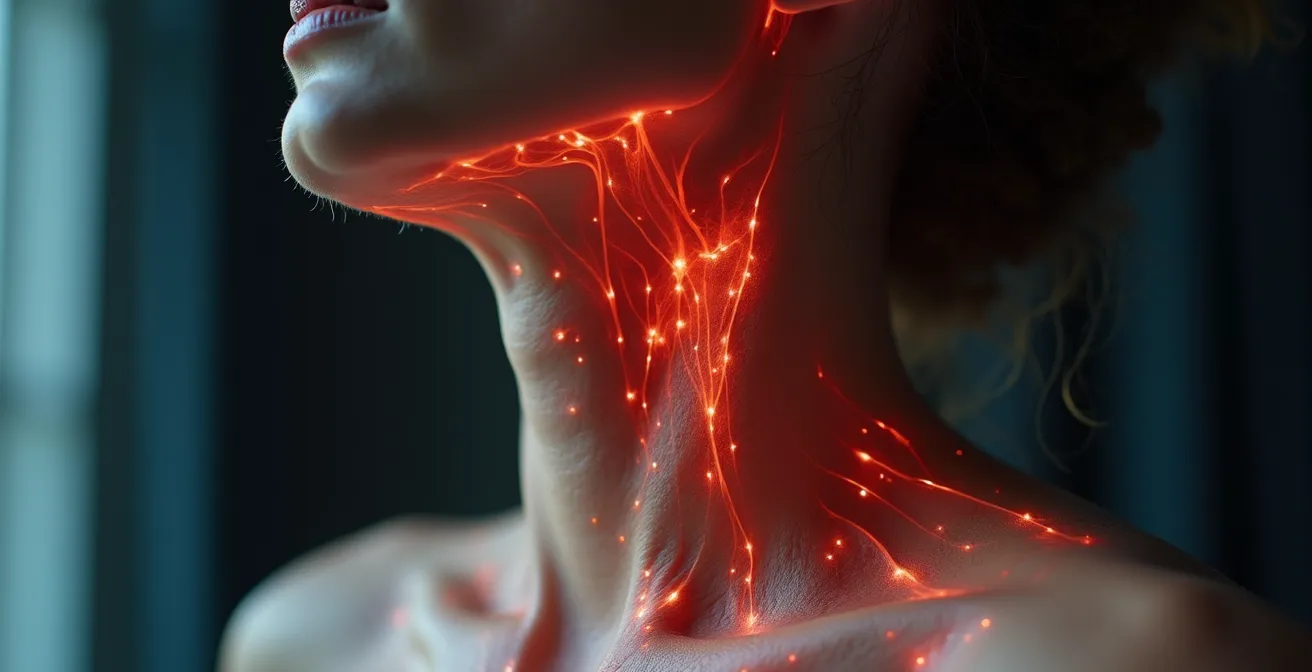
As you can see, this is a deep physiological process. You are not just breathing; you are manipulating the core systems of oxygen and carbon dioxide exchange to create a desired outcome. You are replacing a destructive chemical hit with a constructive physiological one.
You don’t need nicotine to get a head rush. You just need to learn how to control your air.
The 4-7-8 Breathing Technique to Stop a Craving in 2 Minutes
When a powerful craving hits, you need an emergency protocol. The 4-7-8 technique is a highly effective drill for this purpose. It is a more advanced version of box breathing designed to induce a powerful parasympathetic response very quickly. The structure is simple, but the longer hold and forceful exhale make it intensely effective at halting the momentum of an urge.
The protocol is as follows. Execute this cycle a minimum of six times, which takes just under two minutes.
- Inhale for 4 seconds: Breathe in quietly through your nose, filling your diaphragm.
- Hold for 7 seconds: Retain the breath. This is the critical phase where CO2 builds, calming the nervous system and preparing the body for the parasympathetic release.
- Exhale for 8 seconds: Exhale forcefully through your mouth, making an audible “whoosh” sound. The extended duration and forceful nature of this exhale is key to maximizing the vagal nerve stimulation.
This method is not just a folk remedy; it’s a structured technique recommended by health authorities for its immediate impact. The National Cancer Institute’s guidelines for withdrawal management align with this principle, suggesting that 10 deep breath cycles are effective for managing acute symptoms. The 4-7-8 method provides a specific, timed structure for those breaths.
The “whoosh” sound on the exhale is not trivial; it serves as a mindfulness anchor, focusing your attention on the physical act of breathing and away from the mental chatter of the craving. By completing 6-8 cycles, you are chemically and neurologically altering your state, making the craving subordinate to your controlled response.
A craving feels powerful, but it cannot withstand two minutes of targeted, physiological intervention.
4-7-8 Breathing: Using Breath to Fall Asleep Without Smoking
One of the hardest cravings to beat is the pre-sleep cigarette. It’s a deeply ingrained ritual that falsely links nicotine with winding down. As we’ve established, nicotine is a stimulant. It disrupts the quality of your sleep even if it feels like it helps you fall asleep. The 4-7-8 breathing technique is a superior replacement for this ritual, designed specifically to guide the body into a state of rest.
When performed lying down, the 4-7-8 protocol acts as a powerful sedative. The extended breath hold and long exhalation are a potent combination for activating the parasympathetic nervous system. It forces your body out of the alert state that daily stress and nicotine withdrawal create, and into a state conducive to sleep. It physically slows your heart rate and mentally gives your mind a single, rhythmic task to focus on, preventing the racing thoughts that often accompany quitting.
This isn’t just theory; it’s a proven method for individuals struggling with sleep disorders, offering a structured path to relaxation without pharmaceuticals or nicotine.
Case Study: 4-7-8 Breathing Protocol for Sleep Enhancement
In a report on breathing for sleep health, certified yoga instructor Shelley Arthur reports the ‘four-part breath’ is an effective relaxation technique that helped release her from years of sleep disorder when practiced lying down. This provides a clear example of using a structured breathing protocol as a functional replacement for a problematic sleep ritual like an evening cigarette.
To implement this, make it your new nightly ritual. Turn off screens, lie down in bed, and perform the 4-7-8 cycle for 8-10 repetitions. Focus on the sensation of your body becoming heavy and your mind clearing with each long, “whooshing” exhale. You are not just avoiding a cigarette; you are actively improving your sleep architecture and training your body to relax on command.
Conquer the night, and you are one step closer to conquering the addiction for good.
The Error of Making It Obvious: Breathing in Meetings
A common barrier to using breathing techniques is the fear of looking strange in a professional or social setting. The thought of taking a dramatic, deep breath in the middle of a board meeting is a non-starter. This is a legitimate concern, but it’s based on a misunderstanding. Tactical breathing can and should be executed covertly. The goal is control, not performance.
You do not need to make a show of it. The entire technique can be performed silently and with no visible movement other than the subtle expansion of your abdomen, which is hidden by your desk and clothing. You can scale down the rhythm—for instance, to a 2-2-2-2 second box—to make it completely imperceptible while still getting the benefits of rhythmic breathing.
To master covert breathing, use these stealth techniques:
- Scale Down: Use a shorter 2-2-2-2 or 3-3-3-3 rhythm. It’s less powerful but completely unnoticeable.
- Use Anchors: Pair the start of your breathing cycle with a normal action, like taking a sip of water or adjusting your glasses. This masks any initial pause.
- Practice During Downtime: The ideal time to run a few cycles is when someone else is speaking. All attention is on them, giving you a perfect window.
- Maintain Posture: Focus on keeping your shoulders relaxed and down. The only movement should be your diaphragm.
The image below shows the ideal posture: professional, relaxed, and with no outward sign of the powerful physiological work being done internally.

As you can see, a relaxed but engaged posture is key. The technique is internal. This is your secret weapon. No one needs to know you are actively managing a craving and commanding your nervous system. For more on this, resources on covert practice emphasize subtlety.
Your ability to regulate yourself anytime, anywhere is a measure of true control.
Key Takeaways
- Nicotine is a stimulant that increases stress; tactical breathing is a depressant that actively reduces it.
- The key to hacking your nervous system is a long, controlled exhalation, which activates the “rest-and-digest” response.
- Diaphragmatic (belly) breathing is mandatory for effective results; chest breathing perpetuates anxiety.
Urge Surfing: How to Observe a Craving Without Acting on It?
Now, let’s put it all together into a mental framework: Urge Surfing. A craving is not a permanent state. It is a wave of sensation that rises, peaks, and inevitably falls, typically within 3-5 minutes. The mistake is trying to fight the wave. The tactical approach is to “surf” it—to observe it and ride it out using your breath as the surfboard, knowing it will pass.
When the urge begins, don’t panic. Acknowledge it. Name it: “This is a craving.” Then, immediately initiate your box breathing protocol. Your focus shifts from the *sensation* of the craving to the *process* of breathing. Inhale for 4. Hold for 4. Exhale for 4. Hold for 4. You are not fighting the urge; you are giving your brain a more important task. You are observing the wave from the stability of your surfboard.
This is a core principle taught by cessation experts. As Quit.org.au recommends, taking slow deep breaths with long exhales is a primary method to interrupt craving cycles and redirect thoughts. The box breathing protocol provides the optimal structure for this.
The following table visualizes how your breathing intervention maps directly onto the predictable timeline of a craving wave, based on data about craving duration.
This timeline, adapted from craving management resources, shows exactly how to apply your technique.
| Time (minutes) | Craving Intensity | Box Breathing Action |
|---|---|---|
| 0-1 | Rapid rise | Begin 4-4-4-4 rhythm immediately |
| 1-3 | Peak intensity | Maintain steady rhythm, body scan on each phase |
| 3-5 | Gradual decline | Continue cycles until baseline restored |
You are not a victim of your cravings. You are the operator in control of the response. Now, execute.